You shortlisted three [three-phase induction motors](/three-phase-motor/) at similar kW and the cheapest quote looks attractive — until the first bearing fails, the winding shorts after a long cable run, or the nameplate IE class never shows up in field efficiency. Early failure on a VFD-driven induction motor is rarely “bad luck.” It is usually a missing evidence pack: inverter-duty construction, cable and filter assumptions, bearing protection, and material proof that supports the claimed efficiency.
Buyers should treat early VFD motor failures as an evidence problem, not a price problem: verify inverter-duty construction, cable/filter assumptions, bearing protection, and material/process proof for the stated IE class before comparing unit prices in an RFQ.
Let me walk through what field reports actually signal, what marketing labels do and do not prove, which material downgrade risks rise when copper and steel costs move, and how to turn unresolved checks into RFQ questions that make quotations comparable.
What field reports show about early VFD motor failures?
Field reports of early VFD induction motor failures
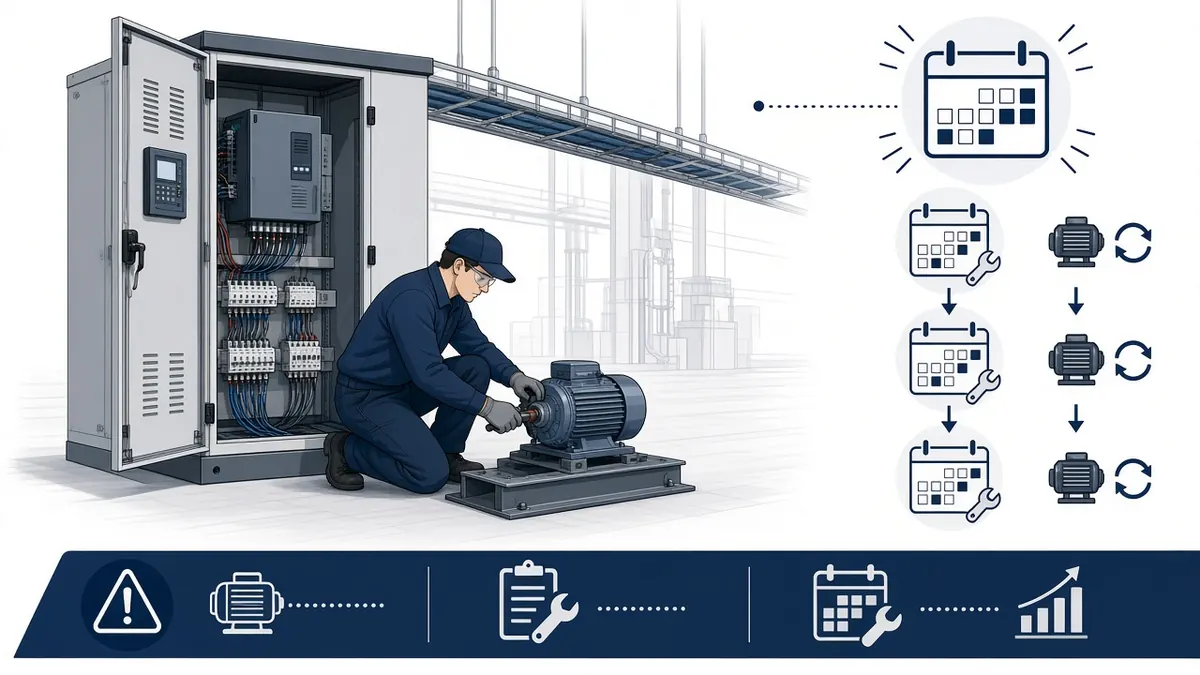
A plant buyer replaces small motors every 1–1.5 years, rewires VFD-to-motor cables repeatedly, and still sees ground faults. Another site finds a 250 ft run with no output filter and standard tray cable, then records bearing failure and insulation failure on separate motors. These are not lab papers. They are buyer-field signals that the installed system — motor, cable, filter, grounding, and drive settings — was never proven as one package before the purchase.
Field reports do not prove a global failure rate, and they are not technical standards. What they do prove is that early failure is a recognizable purchasing risk when VFD duty, cable length, and motor construction are left unresolved at RFQ.
Buyer-field signals from long cable and repeated motor replacement
In one r/PLC discussion, an operator asked whether replacing motors every 1–1.5 years and rewiring the VFD-to-motor run many times was normal. Replies treated that pattern asnot normal, and pointed the conversation toward residual earth current through bearings, isolated bearings, and motor–VFD compatibility — not toward “accept short motor life as a cost of VFDs.” (Reddit field signal)
In a second thread, a buyer described a250 ftmotor lead withno output filter και standard tray cable, then reported motor bearing failure and motor insulation failure. Replies asked whether the motors were inverter-rated and whether cable and motors were suited to the spike environment created by long leads. (Reddit field signal)
I would not treat either thread as a design rule. I would treat them as early warnings: if your RFQ only says “15 kW, 4-pole, IE3, best price,” you have not yet asked the questions these sites needed before purchase.
Field signal
What it suggests for buyers
What it does not prove
Motors replaced every 1–1.5 years on VFD duty
System selection or protection may be incomplete
That all VFD motors fail on that schedule
Repeated VFD-to-motor cable replacements
Cable rating, grounding, or spike stress may be unresolved
That cable brand alone caused every fault
Bearing failure with long leads / no filter
Shaft current or bearing protection may be missing from RFQ
Exact root cause without site measurement
Insulation failure on long cable runs
dv/dt / reflected-wave risk and inverter-grade insulation need evidence
That any named factory “always” fails
Cooling-tower / fan vibration at specific bands (e.g. 24–30 Hz)
Mechanical resonance can sit inside the VFD speed range
A separate AskEngineers discussion describes vibration on a cooling-tower fan motor in a narrow speed band. That is another reminder for OEM buyers: a VFD can park the machine on a mechanical resonance. Resonance is not an insulation standard, but it belongs in the RFQ as a speed-avoidance / stiffness question when the driven machine is a fan or similar torsional system. (Reddit application signal)
Actionable checklist from field signals
Before comparing prices, I would write four site facts into the RFQ cover sheet:
1. Maximum VFD-to-motor cable length and cable type already installed or planned.
2. Whether a dv/dt or sine-wave output filter is in scope (and who supplies it).
3. Whether the motor must be inverter-duty / VFD-compatible on the nameplate and datasheet.
4. Whether insulated bearings, shaft grounding, or both are required for the frame size and installation.
Until those four items are answered, two quotes with the same kW are not comparable.
How do voltage spikes and long cable runs damage windings?
Voltage spikes and long cable runs damaging windings
A buyer sees a competitive induction-motor price, accepts a long motor lead as “already installed,” and omits output-filter language from the RFQ. Months later the winding fails and the argument starts: motor quality vs cable vs drive vs installation. The commercial damage is that the original price comparison never included the spike environment.
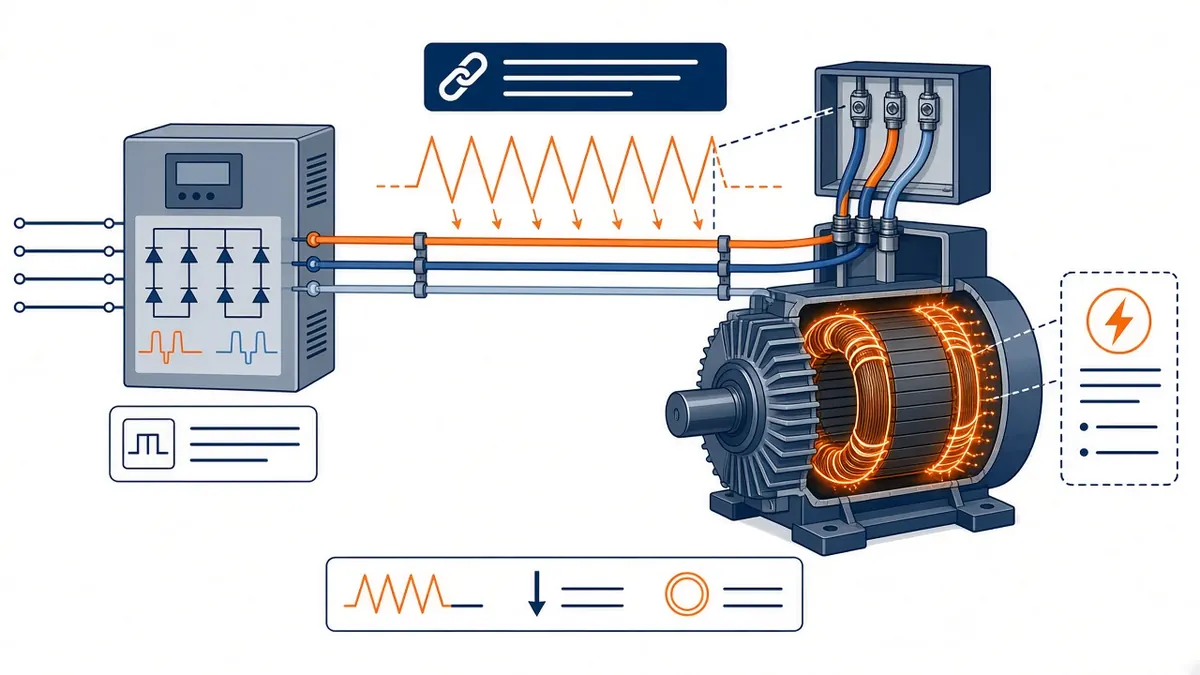
Long cable runs between a PWM VFD and a motor can create reflected-wave voltage stress at the motor terminals. Buyers should treat cable length, cable construction, filter strategy, and inverter-grade insulation as one evidence set — not as optional footnotes after the unit price is approved.
What buyers should ask about spikes and leads
I would not invent a peak-voltage number for your plant. I would ask the supplier and the panel builder to declare, in writing:
Expected cable length used for selection.
Whether the motor insulation system is intended for VFD / inverter supply.
Whether a dv/dt filter, sine-wave filter, or other output filter is assumed.
Whether “VFD-rated cable” is required, recommended, or out of motor-supplier scope.
The second Reddit field signal above is useful here only as a pain pattern: long leads + no filter + standard tray cable appeared together with bearing and insulation failures. That combination should force RFQ language, not a blog claim that every 250 ft run fails.
Evidence item
What public / supplier disclosure can prove
What it does not prove
Nameplate / datasheet “inverter duty” or VFD-compatible wording
Supplier claims the model is intended for inverter supply
That your cable length and filter plan are covered
Cable length assumed in the quotation
Selection boundary for the offer
That the installed cable matches the assumption
Filter recommendation (dv/dt / sine)
Who owns spike mitigation in the scope
That the filter was sized and commissioned correctly
Insulation class (e.g. F or H)
Thermal class of the insulation system
Spike withstand for your specific VFD carrier and lead length
VFD-rated cable requirement
Installation interface for the project
Motor winding quality by itself
Unresolved winding / cable checks for the RFQ
Unresolved check
Required RFQ question
Spike environment unknown
“What maximum motor-lead length is assumed for this quotation, and at what length do you require a dv/dt or sine filter?”
Insulation claim unverified
“Is the quoted motor inverter-duty / VFD-compatible? Provide datasheet wording and insulation system description for PWM supply.”
Cable ownership unclear
“Does your offer require VFD-rated cable, or is cable specification outside motor scope?”
Warranty boundary missing
“If insulation fails with long leads and no filter, what evidence do you require to separate motor responsibility from installation responsibility?”
Why do bearings fail under VFD shaft currents?
VFD shaft currents and bearing failure
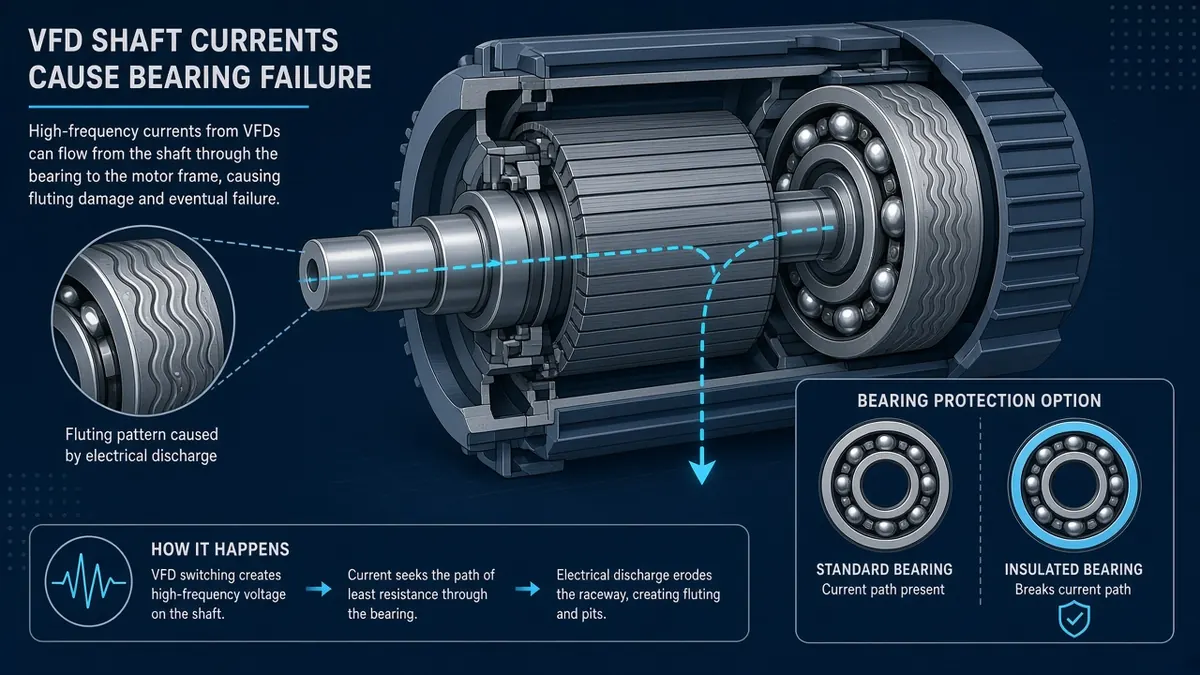
A bearing fails, grease looks burned or fluted, and purchasing is asked for a “better motor” at the next RFQ. Without a bearing-protection line in the first RFQ, the next quote may still be a standard bearing arrangement on a VFD application that needs isolation or shaft grounding.
Common industry practice questions for VFD duty include residual / circulating currents that can pass through bearings. Field discussions often mention isolated bearings and motor–drive compatibility. That does not mean every VFD motor needs the same bearing package. It means the RFQ must name the bearing protection strategy for the frame, voltage, and installation — or accept an unresolved risk.
What to verify on bearings before price comparison
Ask for a written bearing arrangement for the quoted frame:
Standard bearings only, or insulated bearing(s)?
Shaft grounding device required, optional, or excluded?
Which end is insulated (DE / NDE) if only one side is isolated?
Bearing brand / type stated on the datasheet or quote annex?
Bearing claim or symptom
What evidence can support
What it does not prove
“Suitable for VFD” on brochure
Marketing intent
Specific insulated-bearing or shaft-grounding scope
Field report of early bearing failure on VFD
Risk signal for RFQ bearing questions
Root cause without inspection / current path analysis
Quote lists insulated NDE bearing
A defined mechanical interface
Correct installation grounding and cable shield practice
Bearing brand named in RFQ annex
Traceable component choice at quotation time
That substitution will not occur after sample approval
Bearing checklist buyers can attach to RFQ
1. Require the bearing arrangement (insulated / standard / shaft ground) in the quote text, not only in a verbal call.
2. Ask whether the arrangement changes with cable length, filter presence, or frame size.
3. Ask what evidence is needed after a bearing failure to avoid a circular blame loop between motor, drive, and installer.
4. Keep the same bearing scope when you compare three suppliers’ prices.
What does “inverter-rated / VFD-duty” actually prove?
Inverter-rated VFD-duty labels vs RFQ evidence
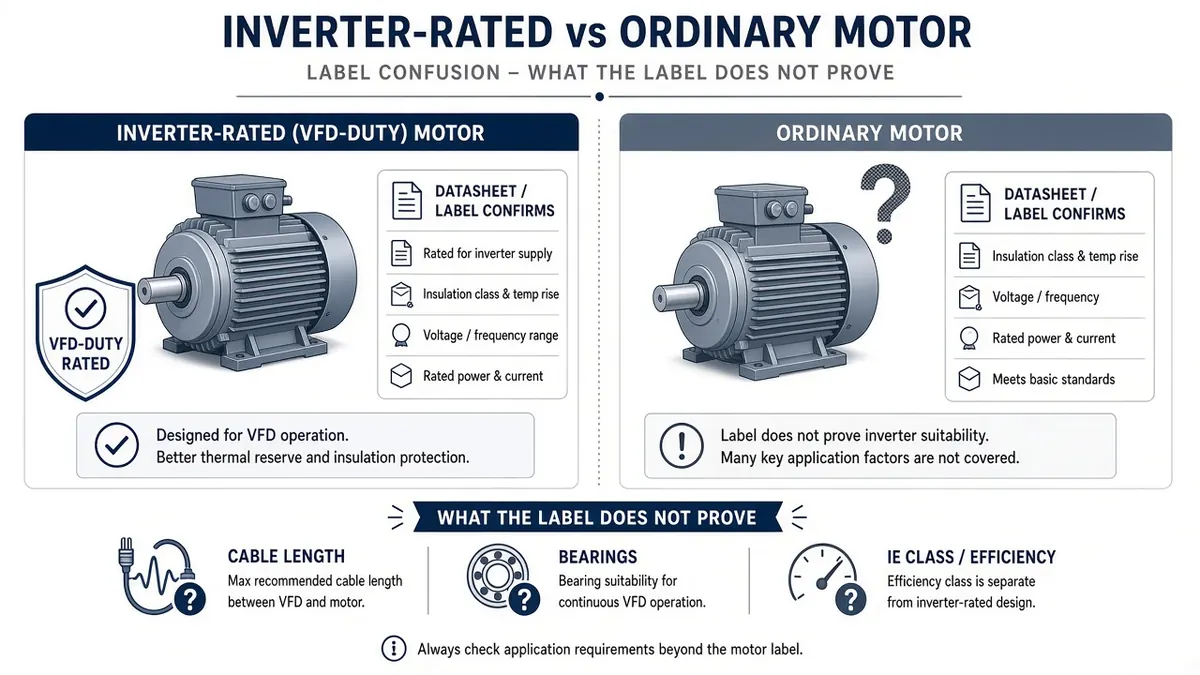
Catalog pages often say “VFD motor,” “inverter duty,” or “suitable for frequency converter.” Buyers then treat the label as proof that insulation, bearings, cooling at low speed, and cable length are all solved. The label is a starting claim. It is not a substitute for nameplate data, datasheet limits, and an RFQ evidence pack.
“Inverter-rated / VFD-duty” proves that the supplier markets the model for inverter supply. It doesnotautomatically prove spike withstand for your lead length, insulated bearings, forced cooling below a stated speed, or that materials support the claimed IE class under cost pressure.
Separate efficiency class from inverter construction
Efficiency class (IE2 / IE3 / IE4) and inverter-duty construction answer different questions.
IE classaddresses energy-efficiency classification under the applicable efficiency framework (for example IEC 60034-30-1 class language used in market practice). EU Ecodesign guidance notes that motors between 75 kW and 200 kW must meetΙΕ4as ofJuly 2023for the categories covered by the regulation, while broader IE3 requirements already applied earlier for large parts of the three-phase range. (EU Ecodesign — electric motors)
US DOEmotor energy conservation activity includes a direct final rule path withcompliance required on and after June 1, 2027for the new standards established in that rulemaking. Buyers shipping into the US should treat destination compliance as an RFQ identity check, not as a brochure slogan. (US DOE — electric motors)
Inverter-duty constructionaddresses PWM supply risks: insulation system intent, possible bearing protection, cooling at reduced speed, and documented speed range.
A motor can be IE3 and still be a poor fit for a long-lead VFD job. A motor can be marketed as VFD-compatible and still need material and test evidence for the IE class printed on the quote.
For [VFD-compatible three-phase motors](/what-are-the-differences-between-vfd-motors-and-ordinary-motors/), I would ask the factory to state both: IE classκαιinverter-duty scope.
Label on quote
What it can prove
What it does not prove
“IE3” / “IE4”
Claimed efficiency class for the model family
Field efficiency on your load point, or inverter spike withstand
“Inverter duty” / “VFD motor”
Intended use with frequency converter (if datasheet agrees)
Cable length, filter, and bearing package for your site
Insulation class F or H
Thermal class
Peak-voltage capability for your VFD settings
IP55 / IP66
Enclosure protection level
Bearing current mitigation
“Same kW as competitor”
Power rating alignment
Same materials, same VFD options, same test evidence
Soft product note for comparable RFQs
If you are building a shortlist of [IE3 series three-phase motors](/ie3-series-electric-motor/) or higher-efficiency options for export projects, ask each supplier — including Dongchun Motor in Zeguo, Wenling, Zhejiang — for the same evidence pack: nameplate data, IE class, IP, insulation class, VFD-duty wording, and the material/process confirmations in the next section. Price only becomes meaningful after those fields match.
How should buyers control material downgrade risk when raw-material prices rise?
Material downgrade risk when raw material prices rise
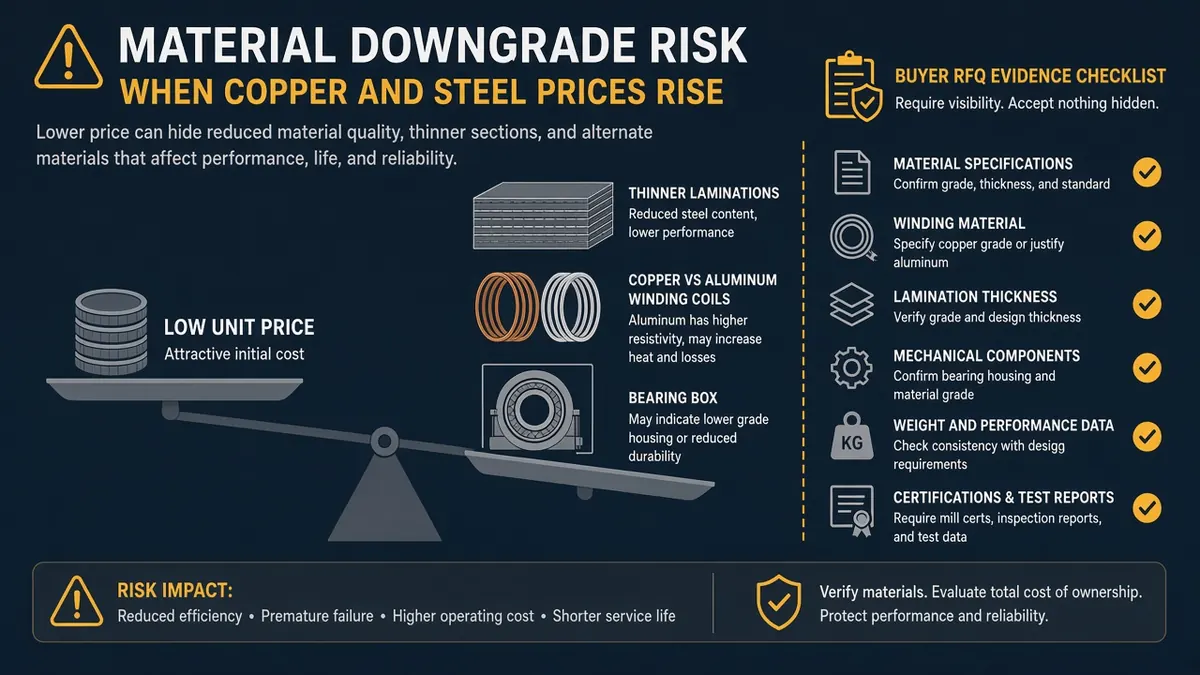
Copper, electrical steel, insulation materials, and bearings move with the market. Under cost pressure, some factories protect a low quote by quietly thinning the bill of materials: lower-grade or thinner silicon-steel laminations, lower copper fill or aluminum where the buyer expected copper, cheaper magnet wire / varnish systems, or inferior bearings. The datasheet still says IE3 or IE4. The delivered motor may not hold the efficiency, temperature rise, or lifetime the buyer thought they bought.
This is amarket risk buyers should control with evidence, not a claim that any named factory cheated on a specific order. The purchasing rule is simple:do not RFQ on unit price alonewhen material substitution can erase the claimed IE class and durability.
Pain framing: the lowest quote often hides the material question
When three offers sit within a few percent on price, the cheapest one may have removed cost from places you cannot see on a PDF catalogue page. Electrical steel grade and thickness, winding metal and fill factor, varnish process, and bearing brand rarely appear in a one-line Proforma Invoice. If you approve price before those fields are locked, you are comparing invoices, not motors.
I would treat rising raw-material periods as a reason toincreaseRFQ evidence, not reduce it.
Supplier claim
What the buyer should verify
Why it matters under cost pressure
“IE3 / IE4 efficiency”
Nameplate IE class + sample routine test / type-test report format for the quoted model family
Efficiency class is a performance claim; materials and process must support it
“Copper winding” (or silence on winding metal)
Explicit winding-material disclosure in the quotation (copper vs aluminum)
Metal substitution changes losses and thermal behavior
“High-quality silicon steel”
Electrical steel grade / thickness if the factory discloses it; otherwise mark as unresolved
Thinner claims without disclosure are not evidence
“Class F insulation”
Insulation classplusprocess evidence (magnet wire / varnish system description or equivalent factory statement)
Class letter alone does not prove process discipline
“Reliable bearings”
Bearing brand and type on quote annex
Bearing is a common cost-cut item and a common VFD wear item
“Same as sample”
Written rule for material substitution after sample / FA approval
Sample bait, production switch is a classic commercial failure mode
Unresolved material and process checks for RFQ
Unresolved check
Required RFQ question / evidence
IE class only on brochure
Provide nameplate IE class for the quoted model and a sample routine-test report format; state whether a type-test summary is available under NDA.
Winding metal not stated
Confirm winding material (copper or aluminum) in the quotation text for the exact model.
Steel grade undisclosed
Disclose electrical steel grade/thickness if available; if not disclosed, state that steel grade isnotpart of the contractual evidence.
Insulation process opaque
State insulation class and the magnet-wire / impregnation process evidence you will supply with the order.
Bearing brand missing
List bearing brand and type (and insulated / standard arrangement for VFD duty).
Post-sample substitution
Confirm in writing: after sample or first-article approval, material substitution requires buyer written agreement, or is prohibited for listed critical parts.
Soft CTA on evidence, not slogans
Serious suppliers should be willing to put material and process evidence into the RFQ pack, not only a unit price. Dongchun Motor can support RFQ packages with nameplate data, IE class, IP, insulation class, and the application questions above for [three-phase induction motors](/three-phase-motor/) — including VFD-compatible selections — so that price comparison happens on the same bill of materials and the same duty boundary. That is a documentation expectation, not a claim that any competitor failed a lab test.
How should buyers structure unresolved checks before comparing price?
RFQ unresolved checks before comparing price
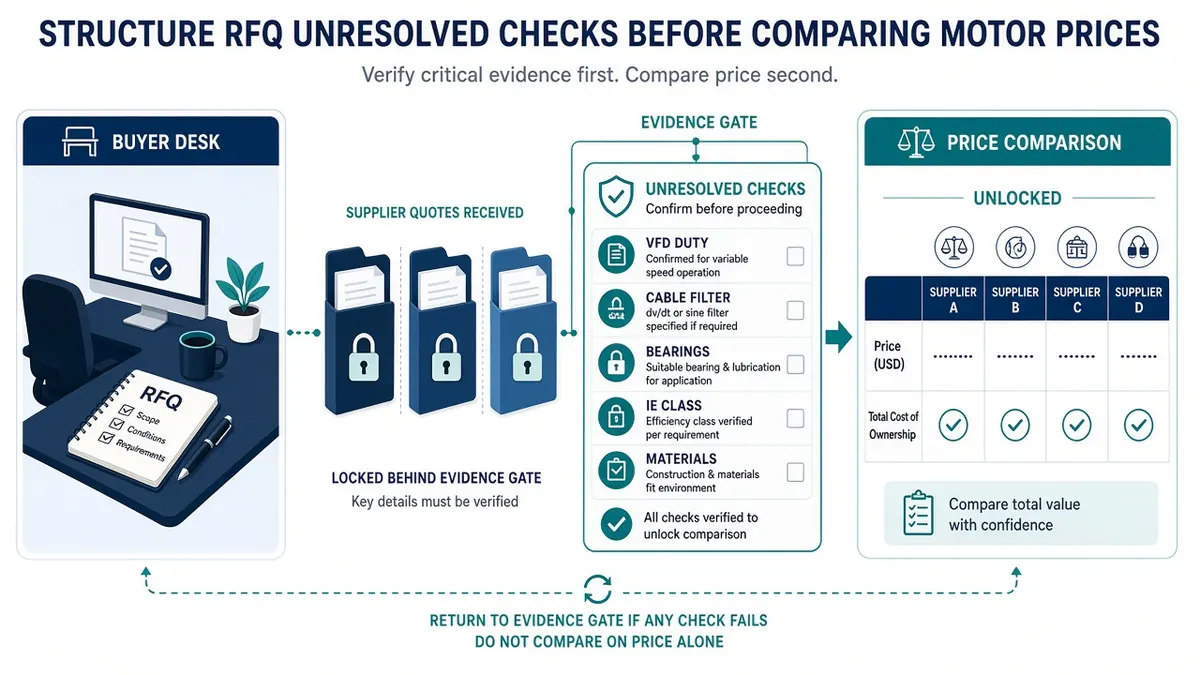
Some claims cannot be closed from a website or a catalogue PDF. Ignoring them means the cheapest quote wins by default. Treating every gap as a deal-breaker may eliminate capable factories. The practical middle path is anexplicit unresolved-check tablethat becomes the technical questionnaire inside the RFQ.
Buyers should structure unresolved checks by listing the claim, the public/field evidence status, and the exact document or declaration required before price ranking.
Master unresolved-check table for VFD induction-motor RFQs
Claim or risk
Public / field evidence status
Required RFQ check
Motor is suitable for VFD / inverter supply
Brochure wording only unless datasheet restates it
Datasheet + nameplate / catalogue wording for inverter duty; speed range and cooling notes
Long cable run is acceptable
Field reports show failures when length + no filter + standard cable coincide
Declare max lead length assumed; filter requirement; cable type ownership
Bearings will survive VFD duty
Field signals mention shaft current / isolated bearings as practice questions
Same kW, IE class, IP, insulation, VFD options, cable/filter assumptions, material disclosures
Integrating the checks into the RFQ pack
Attach the “Required RFQ check” column as a questionnaire. Ask every bidder to answer in the same table. Then rank price only among offers that cleared the same evidence gates.
A practical cover note looks like this:
Please quote a three-phase induction motor for VFD duty. Application: [machine]. Supply: [V / Hz]. Power / poles / mounting: [ ]. Cable length VFD→motor: [ ] m. Output filter: [yes/no/type]. Required IE class: [ ]. IP / insulation class: [ ]. Confirm inverter-duty construction, bearing arrangement, winding material, bearing brand/type, nameplate + routine-test evidence format, and whether material substitution after sample approval is prohibited without written approval. List all exclusions (cable, filter, shaft ground, commissioning).
Dongchun Motor’s factory team in Wenling / Zeguo can work from that evidence pack when preparing a comparable offer for export OEM and distributor RFQs.
FAQ
Is early motor failure on a VFD “normal”?
Buyer-field discussions treat frequent motor and cable replacements asnot normal. Treat early failure as a signal to re-check motor–VFD compatibility, cable length, filters, grounding, and bearings — not as an acceptable operating cost.
Does “inverter-rated” mean I can ignore cable length?
No. Inverter-duty wording addresses motor intent for PWM supply. Cable length, VFD-rated cable, and dv/dt or sine filters are separate interface decisions that belong in the RFQ.
Do IE3 or IE4 labels prove VFD reliability?
No. IE class is an efficiency classification claim. VFD reliability still depends on insulation system intent, bearings, cooling at low speed, installation, and materials that actually support the claimed class.
What should I request when raw-material prices are rising?
Request winding-material confirmation, bearing brand/type, insulation class plus process evidence, IE nameplate + routine-test report format, and a written rule against silent material substitution after sample approval.
What documents make a Dongchun (or any factory) quote comparable?
Same scope sheet for all bidders: nameplate data, IE class, IP, insulation class, VFD-duty statement, bearing arrangement, material disclosures, test-report format, and exclusions for cable/filter/commissioning.
Should price be the first RFQ filter?
No. Filter on evidence gates first, then compare price among offers that cleared the same VFD, cable, bearing, IE, and material checks.
συμπέρασμα
VFD-driven induction motors fail early when buyers compare price before they compare evidence. Field reports about repeated motor and cable replacements, long leads without filters, and bearing damage are purchasing signals — not standards — but they are strong enough to change the RFQ.
Verify inverter-duty scope, cable and filter assumptions, bearing protection, IE-class documentation, and material/process proof before you rank quotations. When raw-material costs rise, treat the lowest unit price as a prompt to ask harder material questions, not as a shortcut.
If you need a comparable offer on [three-phase induction motors](/three-phase-motor/), including VFD-compatible and [IE3](/ie3-series-electric-motor/) selections, send Dongchun Motor the evidence pack above. A factory in Zeguo, Wenling, Zhejiang that answers nameplate, IE class, IP, insulation, bearings, and material confirmation in writing is easier to negotiate with than one that answers only with a number.
Sources
1. Reddit (buyer-field signal, not a standard): “Variable Frequency Drives Constant Maintenance Nightmare (VFD)” — motor replacement every 1–1.5 years; repeated VFD-to-motor wiring replacement; replies emphasize not normal / bearing current / compatibility. https://www.reddit.com/r/PLC/comments/1740lgo/variable_frequency_drives_constant_maintenance/
2. Reddit (buyer-field signal): “VFD output filter vs VFD rated cable” — ~250 ft run, no output filter, standard tray cable; motor bearing failure and insulation failure reported; replies raise inverter-rated motors and spike-capable cabling. https://www.reddit.com/r/PLC/comments/1e1sy41/vfd_output_filter_vs_vfd_rated_cable/
3. Reddit (optional application signal): cooling-tower / fan motor vibration discussion (speed-band resonance risk under VFD). https://www.reddit.com/r/AskEngineers/comments/8z0hkp/anyone_experienced_vibrations_in_a_motor_on_a/
4. European Commission, Ecodesign — Electric Motors: IE3 requirements for broad three-phase ranges; motors 75–200 kW must meet IE4 as of July 2023 under the current regulation narrative. https://energy-efficient-products.ec.europa.eu/product-list/electric-motors_en
5. U.S. Department of Energy — Electric Motors: direct final rule pathway; compliance with new standards required on and after June 1, 2027. https://www.energy.gov/cmei/buildings/electric-motors
6. Quora (optional background only for IE class vocabulary; not used as a regulatory source): difference between IE1 / IE2 / IE3 motor classes. https://www.quora.com/What-is-the-difference-between-IE1-IE2-and-IE3-motor
Support notes for editors:Reddit links are framed strictly as field pain signals. No claim is made that Dongchun tested these Reddit cases. No fabricated lab results or named-factory cheating accusations are included. Material-downgrade content is framed as a market risk buyers should control with RFQ evidence. Soft CTAs point to `/three-phase-motor/`, VFD-compatible three-phase motor wording, and `/ie3-series-electric-motor/`.
 Μετάβαση στο περιεχόμενο