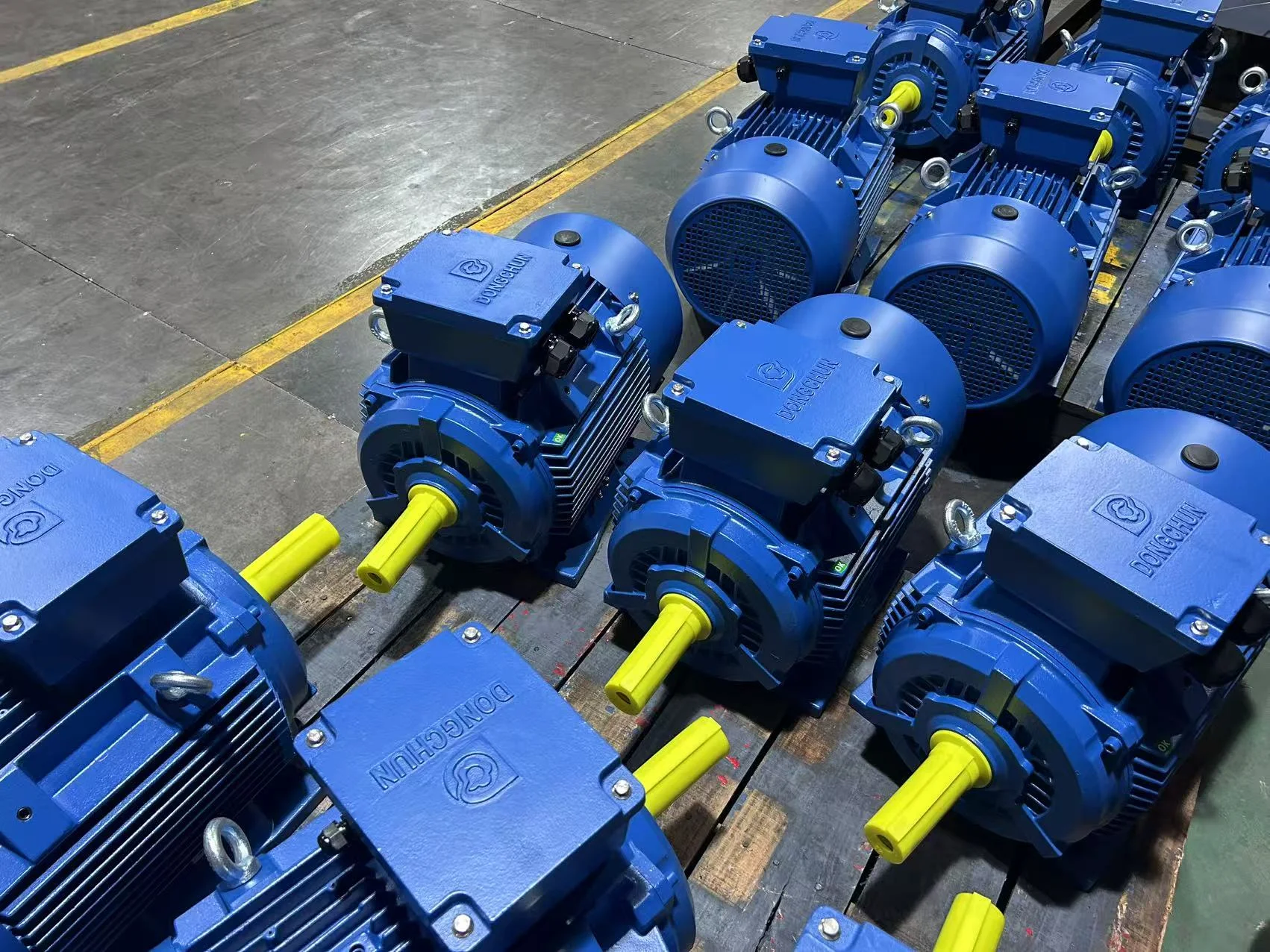
Afgelopen maart stuurde een koper uit Lagos mij om 02.00 uur in de ochtend een bericht via WhatsApp: "De helft van mijn container met 'IE3'-motoren voldoet niet aan de nullasttest. Wat moet ik doen?" Hij had 18% meer betaald dan de budgetleverancier – en kreeg toch een brandwond. Ik run een motorenfabriek in Taizhou, China, en ik krijg bijna elke maand hetzelfde telefoontje. Dus hier is precies hoe ik kopers vertel om een echte Chinese motorleverancier te kiezen, zonder verbrand te worden.
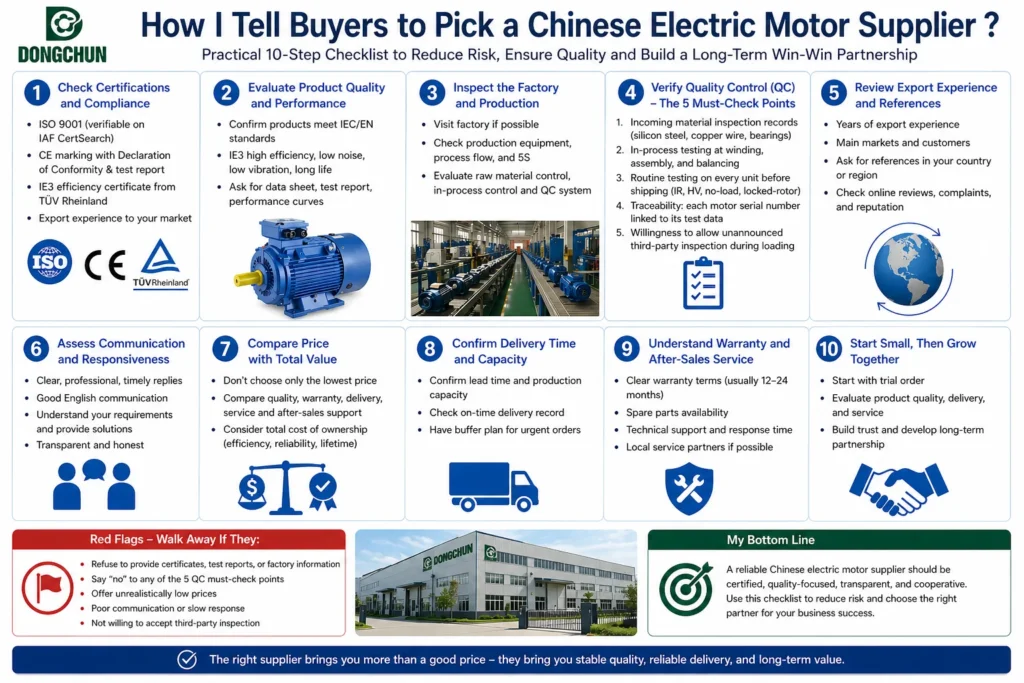
Om een Chinese motorleverancier te kiezen die u kunt vertrouwen, controleert u zeven dingen: (1) TUV-geverifieerde IE3-certificaatnummers die u kunt vinden op Certipedia, (2) ten minste 10 jaar echte fabriekservaring, (3) routinetests op elke motor (isolatie, hi-pot, nullast, vergrendelde rotor), (4) een leveringsrecord van 30 dagen, (5) bereidheid om inspectie door derden toe te staan tijdens het laden, (6) een met name genoemde WhatsApp-contactpersoon die binnen 24 uur antwoordt, en (7) OEM/ODM-geschiedenis met referentieklanten. Begin altijd met een kleine proefbestelling voordat u besluit tot een volle container.
Ik zal u door elk hiervan leiden, op dezelfde manier waarop ik nieuwe kopers er doorheen begeleid tijdens een videogesprek.
Waarom hebben zoveel kopers problemen met Chinese autoleveranciers?
Voordat ik je vertel hoe je een goede kiest, wil ik je eerst vertellen waarom de meeste kopers überhaupt gewond raken.
De meest voorkomende problemen die ik zie zijn: kwaliteitsverschillen tussen monsters en bulk (het aas en de schakelaar), valse of overdreven certificaten, levering die zonder waarschuwing voorbij de 45 dagen glijdt, verkopers zwijgen nadat de aanbetaling is geland, en nul technische ondersteuning na de motorschepen. Minder dan 30% van de kleine en middelgrote Chinese motorfabrieken kan consequent IE3 of hoger halen. Dat ene getal is de reden waarom de selectie van leveranciers belangrijker is dan de prijs.
De Chinese elektromotorindustrie heeft een jaarlijkse productie van meer dan 800 miljard yuan, met duizenden fabrieken variërend van een werkplaats voor tien personen tot een echte OEM met een stempellijn. Die spreiding is precies waarom due diligence belangrijk is.
De kwaliteitskloof tussen monster en bulk
Dit is de voornaamste klacht die ik hoor. Het monster is perfect: juiste efficiëntie, gladde verf, correct naamplaatje. De container arriveert en de motoren zijn anders: ruwere afwerking, ander lagermerk, hogere bedrijfstemperatuur, efficiëntiecijfers die niet overeenkomen met het testrapport.
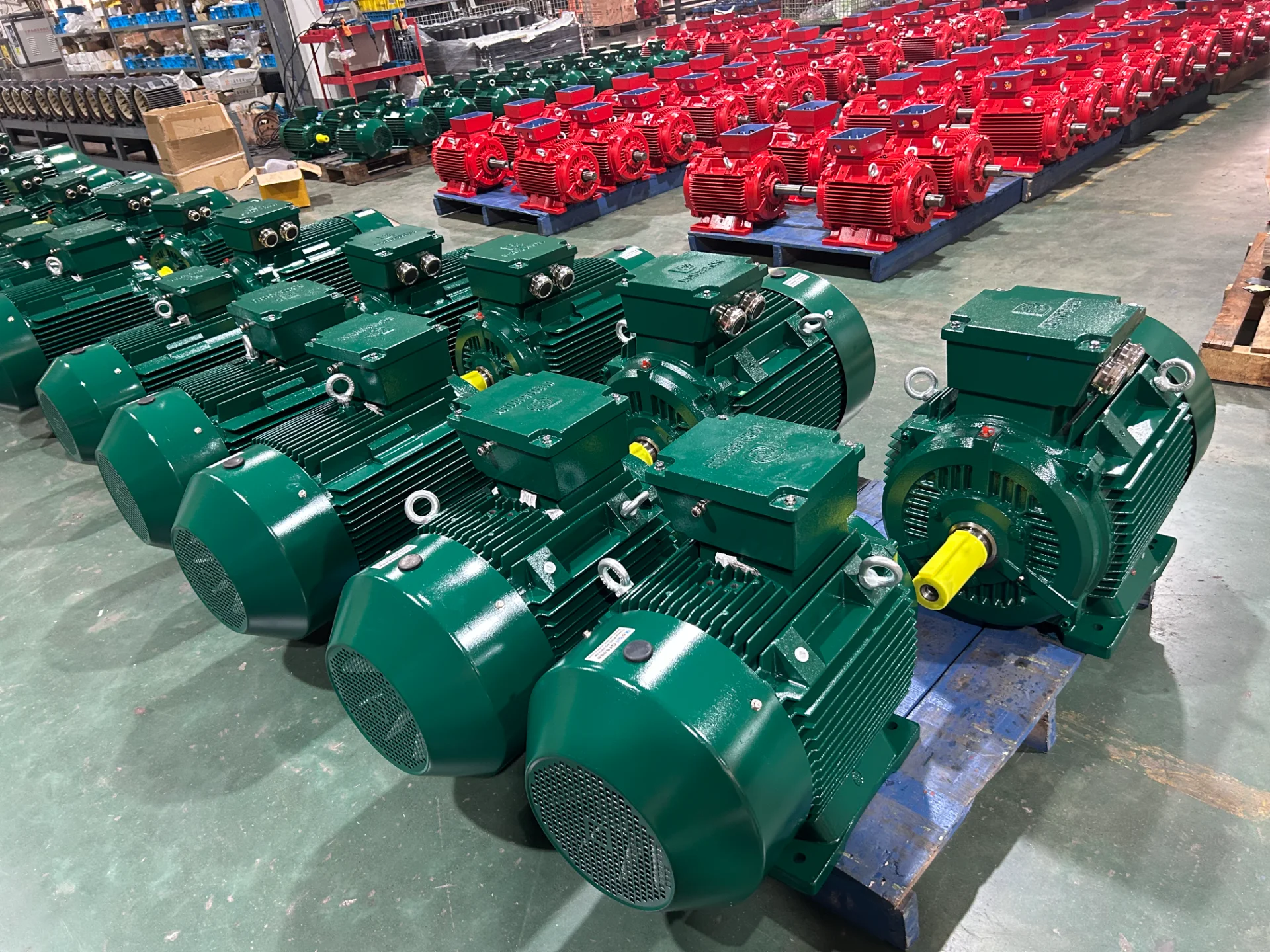
Waarom? Sommige fabrieken bouwen monsters in een ‘showcase’" cel met hoogwaardige materialen en plaats vervolgens bulkbestellingen op een aparte lijn met goedkopere componenten. De gebruikelijke wissels:
Goedkopere lagers (Chinese C&U in plaats van NSK of SKF)
Aluminiumwikkelingen in plaats van koper, of dunner koper
Lamineringen van siliciumstaal van lagere kwaliteit
Klasse B-isolatie in plaats van Klasse F
Dunnere gietijzeren behuizingswanden
Afgelopen september belde een koper uit Quito mij op WhatsApp. Hij had 60 IE3 driefasige motoren van 7,5 kW besteld bij een andere fabriek in Zhejiang. De monsters waren perfect. De houder? Verschillende lagers — Chinese C&U in plaats van NSK. In zijn pompwinkel brandden in de eerste maand drie motoren uit. Hij verplaatste zijn volgende 4-pole order naar ons. Het eerste wat hij vroeg was: mag ik de lagerfacturen van uw leverancier zien?" Ja. Ik stuurde hem dezelfde dag de NSK-factuur en de dag erna het rotorbalanceringsrapport (G2.5-kwaliteit).
Communicatiestoringen
Veel kopers vertellen me hetzelfde verhaal: de communicatie was geweldig vóór de bestelling, maar daarna stortten de responstijden in. Vragen over de voortgang van de productie, verzending of technische specificaties bleven dagenlang onbeantwoord. Dat betekent meestal dat het verkoopteam afstandelijk is, of dat de fabriek te veel capaciteit aan te veel klanten tegelijk toewijst.
Het certificeringsprobleem
Ik zal eerlijk tegen je zijn: ergens tussen de 10% en 30% van de certificaten die je op PDF's van Chinese leveranciers ziet, zijn nep of misleidend. Voor motoren zijn de twee gevarenzones IE3-efficiëntieclaims zonder echte TUV-tests, en CE-verklaringen zonder ondersteunend testrapport. Sinds 2019 [IE3 is het wettelijke minimum in de hele EU](https://link.springer.com/chapter/10.1007/978-3-030-69799-0_16)1 voor industriële laagspanningsmotoren van 0,75 kW tot 375 kW, met vergelijkbare regels in Brazilië, Mexico en Korea. Als uw leverancier geen echt TUV-gestempeld testrapport kan laten zien, kijkt u naar douaneblokken voordat u de koper bereikt.
Voor meer informatie over het herkennen van valse certificaten, zie onze interne gids met tips voor het verifiëren van motorrijbewijzen (ik zal dit in een vervolgartikel bespreken).
Minder dan 30% van de kleine en middelgrote Chinese motorfabrikanten kan consequent IE3-motoren of motoren met een hoger rendement op schaal produceren.WAAR
Uit een sectoranalyse van de Chinese autosector blijkt dat, hoewel de totale productie jaarlijks meer dan 800 miljard yuan bedraagt, alleen fabrikanten met aanzienlijke investeringen in premium siliciumstaal (50W470 of beter), zeer zuivere koperwikkelingen, nauwkeurige rotorbalancering (G2.5-kwaliteit) en full-batch-testen IE3 op betrouwbare wijze kunnen bereiken. De meeste kleine werkplaatsen beschikken niet over de uitrusting en het materiaal om dit consequent te doen.
Alle Chinese motorfabrieken gebruiken dezelfde grondstoffen en processen, dus het kwaliteitsverschil zit vooral in het merklabel.Vals
De kwaliteitsverschillen tussen Chinese motorfabrikanten zijn enorm. Verschillen in siliciumstaalkwaliteit, koperzuiverheid, lagermerk (NSK/SKF versus C&U), isolatieklasse (B versus F versus H), rotorbalanceringsprecisie en routinetests zorgen voor grote prestatieverschillen. Een 4-polige motor van 5,5 kW uit een premiumfabriek kan 15-20 jaar meegaan; een vergelijkbaar ogende budgetmotor valt vaak binnen 3-5 jaar uit.
Welke certificeringen moet een Chinese motorleverancier hebben?
Certificaten zijn het meest objectieve filter dat u heeft, maar alleen als ze echt zijn.
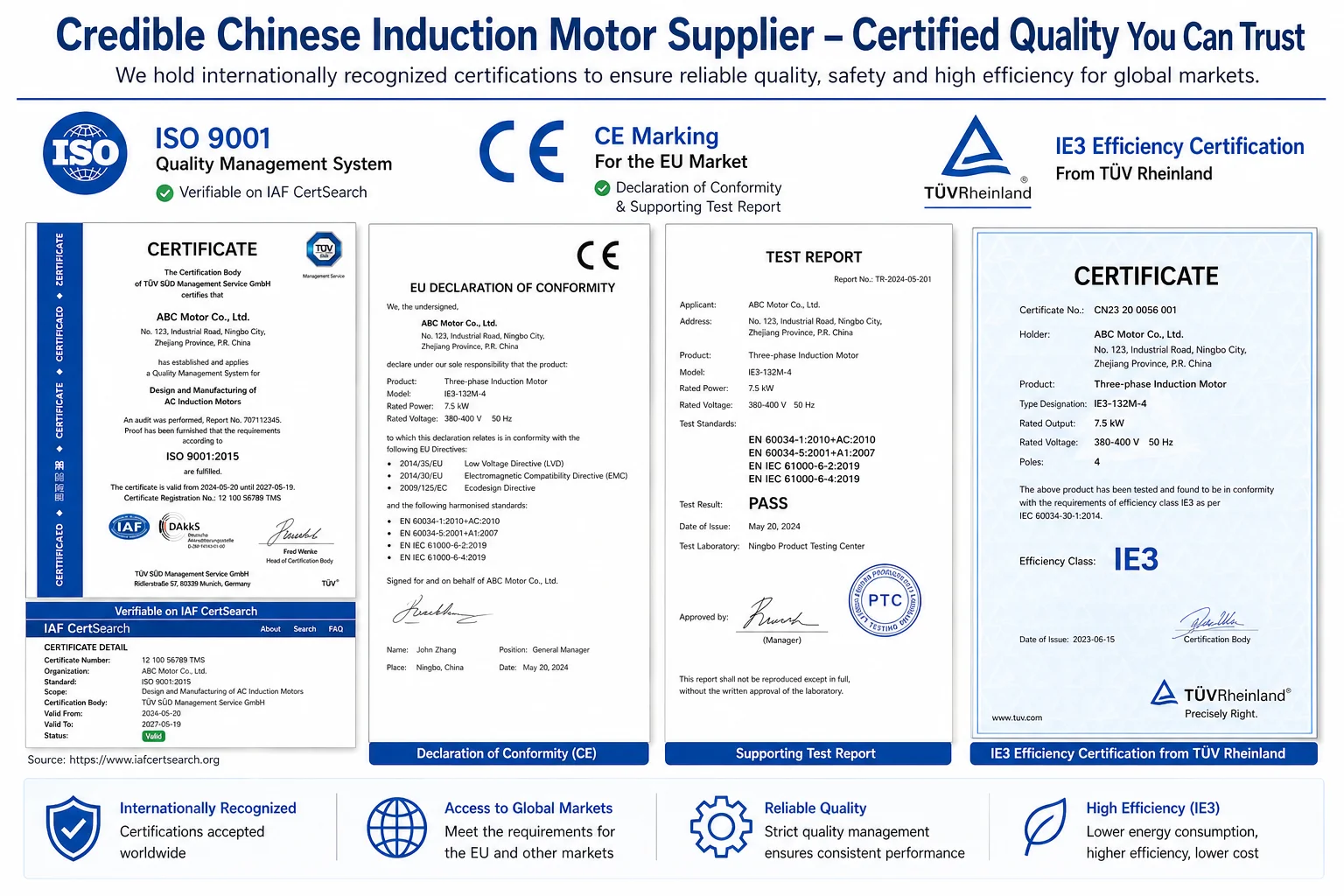
Een geloofwaardige Chinese motorleverancier moet in het bezit zijn van ISO 9001 (verifieerbaar op IAF CertSearch), CE-markering met een conformiteitsverklaring en ondersteunend testrapport voor de EU-markt, en IE3-efficiëntiecertificering van TUV Rheinland, TUV SUD, SGS of Bureau Veritas. Vraag voor extra vertrouwen om CCC voor de Chinese binnenlandse markt en IECEE CB-schemacertificaten voor internationale acceptatie. Controleer altijd het certificaatnummer in de database van de uitgever, niet in de pdf van de leverancier.
Niet elk certificaat weegt even zwaar. Hier is hoe ik kopers vertel om prioriteiten te stellen.
Prioriteitsmatrix voor certificering
Certificering
Wat het bewijst
Hoe te verifiëren
Prioriteit
ISO9001
Er bestaat een kwaliteitsmanagementsysteem
IAF CertSearch
Essentieel
CE-markering
Voldoet aan de EU-veiligheidsrichtlijnen
Vraag DoC + testrapport aan
Essentieel voor de EU
IE3 door TUV
Efficiëntie onafhankelijk getest
Certipedia- of TUV SUD-certificaatzoeker
Hoog
CCC
Voldoet aan de verplichte Chinese normen
CNCA-database
Goed signaal
IECEE CB
Testresultaten geaccepteerd in meer dan 50 landen
CB-certificatendatabase
Handig voor meerdere markten
ATEX
Veilig voor explosieve atmosferen
Verificatie van aangemelde instantie
Als u verkoopt aan olie en gas
Certificeringen gebruiken tijdens leveranciersevaluatie
Vraag niet alleen maar: "Heeft u een CE-certificering?" — elke leverancier zal ja zeggen. Ik vertel elke nieuwe koper hetzelfde: vraag naar het specifieke certificaatnummer en ga het dan zelf controleren. Vijf stappen:
Vraag naar het exacte certificaatnummer
Controleer het in de database van de uitgevende instantie
Controleer of de reikwijdte de exacte motormodellen omvat die u nodig hebt (een YE3 4-polig 5,5 kW-certificaat dekt niet een YE3 2-polig 11 kW)
Controleer of het certificaat actueel is en niet verlopen
Controleer of de naam van de fabrikant op het certificaat overeenkomt met de rechtspersoon waarnaar u geld overmaakt
Wanneer ik een koper mijn certificaatnummers overhandig en hem vertel dat hij dit moet verifiëren op Certipedia, laat ik zien dat ik niets te verbergen heb. Als een concurrent zenuwachtig wordt als u erom vraagt, is dat uw antwoord.
Het TUV-voordeel
Van de motorefficiëntiecertificeringen van derden weegt TUV (Rheinland, SUD of NORD) het meeste gewicht. Een TUV-geverifieerd IE3-certificaat betekent dat echte motormonsters naar een TUV-laboratorium zijn gegaan, dat de tests IEC 60034-30-1 hebben gevolgd, dat de efficiëntie onafhankelijk is gemeten (niet zelf verklaard) en dat het certificaat publiekelijk kan worden gecontroleerd op [de TUV-certificatendatabase](https://www.certipedia.com/)2. Dit is een veel hogere lat dan een zelfondertekende CE-markering of een certificaat van een onbekend laboratorium.
Een TUV-geverifieerd IE3-efficiëntiecertificaat betekent dat fysieke motormonsters zijn getest in TUV-laboratoria volgens IEC 60034-30-1, en dat het resultaat openbaar doorzoekbaar is op Certipedia of de TUV SUD Certificate Finder.WAAR
TUV-certificering voor motorefficiëntie vereist dat de fabrikant fysieke monsters naar een TUV-testfaciliteit stuurt. Ingenieurs voeren efficiëntietests uit volgens de IEC 60034-30-1-methode en de resultaten worden gepubliceerd in openbaar toegankelijke databases. Dit geeft een onafhankelijke, verifieerbare plaat die kopers binnen twee minuten kunnen controleren.
Een CE-markering op een Chinese motor betekent dat een Europese certificeringsinstantie deze vóór export heeft getest en goedgekeurd.Vals
CE-markering is een eigen verklaring van conformiteit van de fabrikant met EU-richtlijnen, en geen goedkeuring afgegeven door een Europese instantie. De fabrikant ondertekent de conformiteitsverklaring en brengt zelf de CE-markering aan. Volgens de laagspanningsrichtlijn zijn tests door derden wettelijk niet vereist voor standaard industriële motoren, dus veel Chinese motoren zijn voorzien van CE-markeringen zonder dat er een onafhankelijke test achter zit.
Hoe evalueer je de kwaliteitscontrole van een motorfabriek?
Certificaten vertellen u op papier over het systeem. Een fabrieksrondleiding vertelt u over de dagelijkse praktijk.
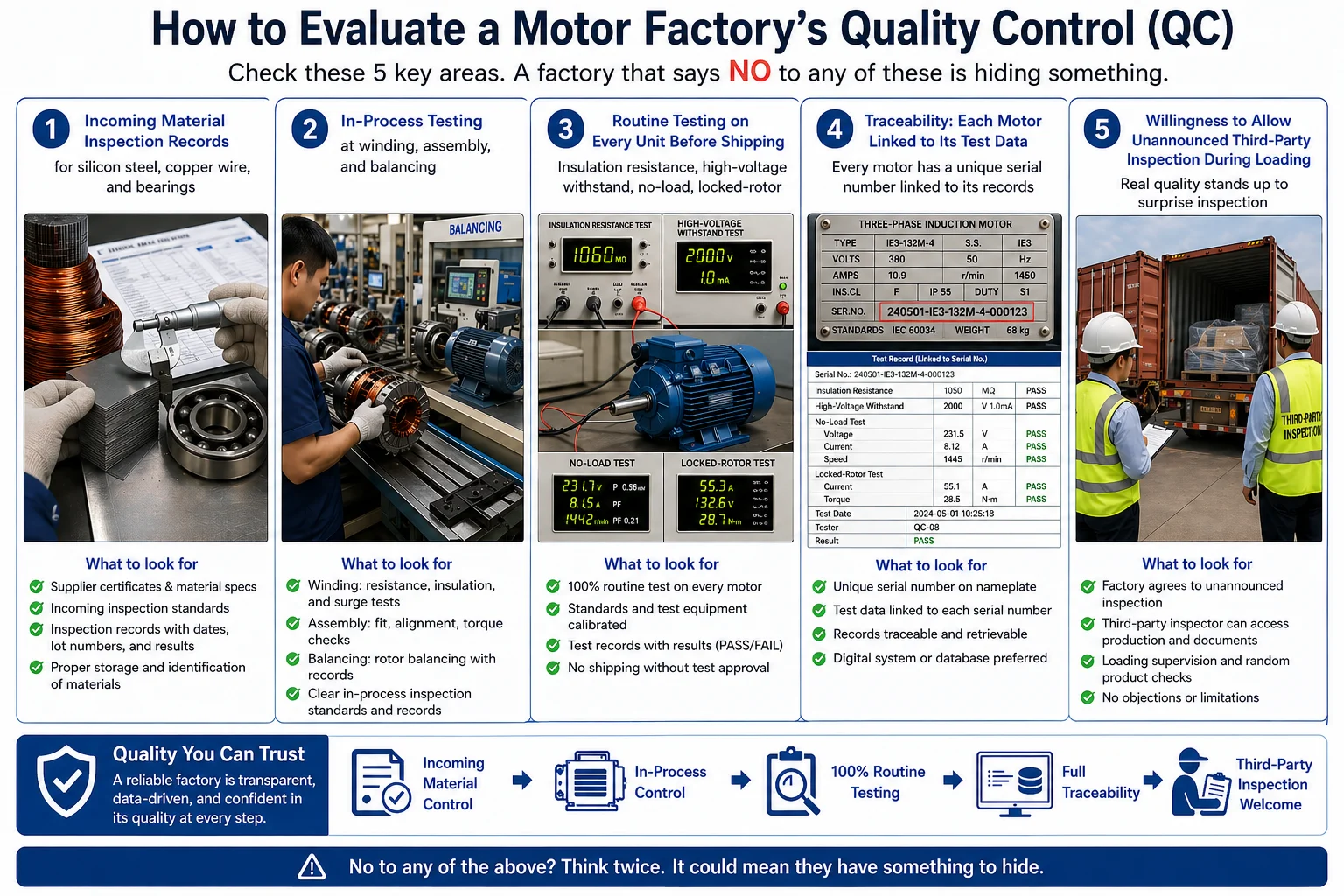
Evalueer de kwaliteit van een motorfabriek door vijf dingen te controleren: (1) binnenkomende materiaalinspectiegegevens voor siliciumstaal, koperdraad en lagers, (2) testen tijdens het proces bij het wikkelen, assembleren en balanceren, (3) routinetesten op elke eenheid vóór verzending (isolatieweerstand, bestand tegen hoge spanningen, nullast, vergrendelde rotor), (4) traceerbaarheid die elke motorserie koppelt aan de testgegevens, en (5) bereidheid om onaangekondigde inspectie door derden toe te staan tijdens het laden. Een fabriek die nee zegt tegen dit alles, verbergt iets.
Een fabrieksrondleiding – persoonlijk of via een videogesprek – vertelt u meer over kwaliteitsbetrokkenheid dan welk certificaat dan ook. Vorige maand liep ik met een pompdistributeur uit Athene door onze lijn tijdens een videogesprek van 40 minuten. Hij vroeg om de G-klasse-meting van de rotorbalancering op drie willekeurige motoren, en we lieten hem de live-uitlezing op de dynamische balancer zien. De week daarop plaatste hij een bestelling van 200 B5 4-polige 1,5 kW.
Belangrijke kwaliteitscontrolepunten in de motorproductie
Productiefase
Wat te controleren
Rode vlag
Grondstoffen
Inkomende inspectiegegevens, leverancierscertificaten voor staal en koper
Geen gegevens, onbekende merken
Statorwikkeling
Draadspanning, vulfactormeting
Handmatig opwinden zonder procescontrole
Rotorbalancering
Dynamische balancer, kwaliteit G2.5 of G1.0
Geen balancer zichtbaar op de vloer
Montage
Lagerpersgereedschappen, uitlijningsmeting
Met hamer gemonteerde lagers
Verf en afwerking
Verfdiktemeter, hechtingstest
Druppels, roestvlekken, ongelijkmatige coating
Laatste testen
Elke eenheid getest, gegevens geregistreerd
Alleen voorbeeldtesten, geen gegevensretentie
Het definitieve testprotocol
Een serieuze motorfabriek voert deze allemaal uit op elke afzonderlijke motor voordat deze wordt verzonden:
Isolatieweerstandstest — verifieert de isolatie van de wikkelingen, minimaal 100 Megohm
Hoogspanningsbestendigheidstest (hi-pot) — past gedurende één minuut 2x nominale spanning + 1000 V toe om isolatiedefecten op te sporen
Onbelaste test — meet stroom en vermogen bij nominale spanning zonder mechanische belasting, verifieert de mechanische montage
Test met vergrendelde rotor — meet de startstroom en het koppel
Trillingstest — bevestigt rotorbalans en lagerconditie
Vraag direct aan de leverancier: ‘test je elke motor, of test je proefmonsters?" Fabrieken die elke eenheid testen, investeren echt geld: de testbank alleen al kost 50.000 tot 200.000 dollar per lijn, en voegt 15 tot 30 minuten arbeid per motor toe. Fabrieken die monsters testen, besparen geld en nemen het risico voor u over.
Inspectie door derden
Voor elke container boven de 20.000 dollar kunt u SGS, Bureau Veritas of Asia Inspection inhuren om tijdens het laden te inspecteren. Het kost ongeveer USD 300-500 per mandag. Op een container van USD 40.000 is dat een verzekeringspremie van 1%. Boek de inspectie altijd tijdens de laadfase. Zo kijkt de inspecteur naar de daadwerkelijke motoren die de container ingaan, en niet naar een vooraf geselecteerde showcasebatch die in een ander magazijn wordt tentoongesteld.
Voor meer informatie over het kiezen van de juiste efficiëntieklasse, zie onze IE3 versus IE2-vergelijking (ik zal hier binnenkort een speciaal bericht over publiceren).
Een compleet routinematig motortestprotocol volgens IEC 60034-1 omvat isolatieweerstands-, hoogspanningsbestendigheids-, nullast- en vergrendelde rotortests op elke unit vóór verzending.WAAR
Deze vier tests vormen het internationaal erkende minimum voor de kwaliteitsborging van elektromotoren, gespecificeerd in IEC 60034-1 als routinetests. Ze verifiëren de integriteit van de isolatie, de diëlektrische sterkte, de kwaliteit van de mechanische montage en de startprestaties. Gerenommeerde fabrikanten draaien alle vier op 100% van de productie, niet alleen op monsters – en registreren de gegevens aan de hand van het motorserienummer.
Als een motor de eindtest in de fabriek doorstaat, functioneert deze gegarandeerd correct gedurende de volledige nominale levensduur.Vals
Laatste fabriekstests verifiëren dat de motor correct is gebouwd en vrij is van defecten bij verzending. Ze voorspellen geen betrouwbaarheid op de lange termijn, die afhankelijk is van de bedrijfsomstandigheden, het onderhoud, de omgevingstemperatuur en de materiaalkwaliteit over de jaren heen. Een motor kan elke fabriekstest doorstaan en toch vroegtijdig uitvallen als de kwaliteit van siliciumstaal onder de maat is, de isolatieklasse verkeerd is voor de bedrijfstemperatuur of als de lagers van budgetkwaliteit zijn.
Welke leverings- en communicatienormen moet u verwachten?
Betrouwbare leveringen en duidelijke communicatie onderscheiden professionele exporteurs van fabrieken die bestellingen aannemen die ze niet kunnen uitvoeren.
Voor standaard IEC-motorbestellingen kunt u een levertijd van 25-35 dagen verwachten voor een container van 1x20ft met voorraadmodellen, en 40-60 dagen voor aangepaste specificaties (speciale spanning, montage, verf of OEM-merk). Een serieuze leverancier geeft u binnen 48 uur na orderbevestiging een productieschema, wekelijkse voortgangsfoto's en proactieve vertragingsmelding. De routinematige responstijd moet minder dan 24 uur bedragen, en minder dan 4 uur voor dringende productieproblemen.
Levering is waar de meeste leveranciersrelaties kapot gaan. Het op papier krijgen van realistische tijdlijnen en duidelijke communicatieprotocollen voorkomt de meeste geschillen.
Realistische doorlooptijdverwachtingen
Besteltype
Typische doorlooptijd
Opmerkingen
Standaardmodellen, standaard 400V/50Hz
20-30 dagen
Als de fabriek de belangrijkste componenten op voorraad houdt
Standaard assortiment, op bestelling gemaakt
30-45 dagen
Normale cyclus voor niet-standaard IEC-motoren
Aangepaste spanning (bijv. 440V/60Hz voor Peru)
35-50 dagen
Vereist een nieuw ontwerp van de wikkeling
Aangepaste verf en OEM-branding
30-40 dagen
Voegt 3-7 dagen toe voor het uitharden van de verf
Niet-standaard montage (B5/B14/B35)
40-60 dagen
Mogelijk zijn er aanpassingen aan het flensgietwerk nodig
Volledig op maat gemaakte OEM
60-90 dagen
Tooling, prototype, monstergoedkeuring
Een koper van voedselmachines in Bangkok wilde afgelopen kwartaal 80 motoren op 380V/50Hz B3-gemonteerde IE3 4-polig 4kW - voorraadspecificatie voor mij. We hebben de container op dag 28 geladen. Hij vertelde me dat zijn vorige leverancier 45 dagen had opgegeven en was teruggevallen naar 70 dagen.
Beste praktijken op het gebied van communicatie
Leg deze vóór uw eerste bestelling schriftelijk vast:
Primair contact — genoemde persoon, direct WhatsApp-nummer
Reservecontact — tweede persoon die urgente kwesties behandelt
Schema bijwerken — hoe vaak u foto's van de voortgang van de productie krijgt
Escalatie pad — met wie u contact opneemt als het primaire contact verdwijnt
Documentatie taal — bevestig dat alle technische documenten in het Engels (of uw taal) zijn
Een fabriek die hiermee instemt en zich eraan houdt, investeert in de relatie, niet alleen in de transactie.
Garantie en ondersteuning na verkoop
De industriestandaardgarantie bedraagt 12-18 maanden. Een fabriek die 24 maanden garantie biedt, geeft aan dat er vertrouwen is in de constructie. Wanneer u de garantievoorwaarden controleert, vraag dan:
Geldt dit alleen voor vervanging, of ook voor verzending naar China?
Wat is het claimproces: foto's en video, of moet u de motor terugsturen?
Is er technische ondersteuning op locatie beschikbaar voor grote bestellingen of terugkerende problemen?
Kan de fabriek u handleidingen voor motoronderhoud in uw taal sturen?
Heeft u een monster nodig om te verifiëren voordat u zich vastlegt? De meeste fabrieken rekenen er kosten voor. Dat doen wij niet bij de eerste 1-2 eenheden voor gekwalificeerde B2B-kopers.
Een productietijd van 25-35 dagen voor een 1x20ft container met standaard IEC-motoren van een gevestigde Chinese fabriek is realistisch en haalbaar.WAAR
Voor fabrieken met efficiënte toeleveringsketens en componenteninventaris zijn 25-35 dagen haalbaar voor standaard IEC-motoren. De cyclus bestaat uit materiaalvoorbereiding (5-7 dagen), wikkelen en monteren (10-15 dagen), verven en routinetesten (5-7 dagen) en verpakken en laden (3-5 dagen). Fabrieken die veel korter offertes aanbieden, bezuinigen meestal op het testen of uitharden van de verf.
De goedkoopste motorleverancier heeft altijd de slechtste kwaliteit, dus kies voor de zekerheid altijd de duurste optie.Vals
Prijs en kwaliteit zijn in de auto-industrie niet perfect lineair. Sommige middengeprijsde fabrieken leveren uitstekende kwaliteit omdat ze efficiënt werken en minder overhead hebben. Sommige dure leveranciers rekenen hogere prijzen voor de marges van tussenpersonen, en niet voor betere motoren. De juiste aanpak is om de kwaliteit onafhankelijk te beoordelen – certificaten verifiëren, kwaliteitscontrole uitvoeren, monsters testen, referenties controleren – en vervolgens de prijzen vergelijken tussen de leveranciers die de poort passeren.
Hoe Dongchun deze 7 problemen oplost
Na al het werk, hier is hoe Dongchun (iecmotores.com) specifiek de zeven problemen beantwoordt waar ik zojuist doorheen ben gelopen. Ik heb deze tafel vorige maand voor een koper in Santiago gebouwd - hij vroeg me om zijn pijnpunten in kaart te brengen met mijn feitelijke antwoorden, en dat is wat hieronder staat.
Dongchun is een laagspanningsmotorspecialist die zich bezighoudt met eenfasige ML/MY/YC/YCL-serie (0,09-7,5 kW) en driefasige IE1 tot en met IE5 (0,09-315 kW), in 2-polig tot 8-polig, IP55-standaard, klasse F-isolatie, B3/B5/B14/B35-montage. Ons IE3-certificaat is TUV-geverifieerd en doorzoekbaar op Certipedia. Standaard levertijd is 30 dagen voor een 1x20ft container. De garantie bedraagt 2 jaar – een jaar langer dan de industriestandaard. Volledig maatwerk op het gebied van spanning (220-690V, 50/60Hz), montage, lakkleur en OEM-naamplaatje.
Probleem-naar-antwoord-kaart
Algemeen probleem
Dongchun's specifieke antwoord
Kwaliteitskloof tussen monster en bulk
Eén productielijn: dezelfde NSK-lagers, hetzelfde 50W470-siliciumstaal, dezelfde klasse F-isolatie in monsters en bulk. Op verzoek stuur ik de lagerleveranciersfactuur.
Valse certificaten
Door TUV uitgegeven IE3-certificaat met het certificaatnummer erop. Zoek het zelf op Certipedia in 60 seconden.
Levering voorbij 45 dagen
Standaard levering binnen 30 dagen op 1x20ft container met standaard IEC-modellen. Wekelijkse foto's met datumstempels vanaf dag 7.
Het verkoopteam wordt stil
Genoemd WhatsApp-contact, 24-uurs reactie op routine, 4 uur op urgentie. Mijn directe lijn is op de PI.
Gebrek aan technische ondersteuning
Engelse onderhoudshandleidingen, maathulp via WhatsApp, probleemoplossing met video over lager- of wikkelproblemen.
Beperkte aanpassing
220-690V, 50/60Hz, B3/B5/B14/B35 bevestigingen, aangepaste verf (RAL-codes), OEM-naamplaatje, aangepaste as binnen frame.
Korte garantie
2 jaar garantie (industrie is 12-18 maanden). Foto-/videoclaimproces — u hoeft motoren niet terug te sturen naar China.
Klanten die dit hebben getest
Een pompdistributeur in Lima plaatste drie herhaalbestellingen voor IE3 4-polige 7,5 kW nadat zijn eerste proef met 50 eenheden zijn eigen testbank had doorstaan
Een machinegroep uit Athene stapte over van een fabriek in Zhejiang naar ons nadat hun vorige lot van 200 eenheden mislukte met hi-pot op de locatie van de klant
Een industriële koper uit Lagos liet onze motoren draaien tegen een Chinees budgetmerk met dezelfde pompcapaciteit - de onze draaide veertien maanden later nog steeds, het budgetmerk had het in de eerste vier maanden gefaald
Een OEM uit Zuid-Afrika gebruikt onze YE3-serie op 525 V 50 Hz met hun eigen naamplaatje, maandelijkse cadans van 100 eenheden
De IE3-efficiëntiecertificering van Dongchun Motor wordt uitgegeven door TUV en kan onafhankelijk worden geverifieerd via openbaar toegankelijke TUV-certificaatdatabases zoals Certipedia.WAAR
Dongchun beschikt over een IE3-efficiëntiecertificering, geverifieerd door TUV en gedocumenteerd in de officiële certificaatdatabases van TUV. Kopers kunnen het certificaatnummer op Certipedia opzoeken en bevestigen dat het actueel is en betrekking heeft op het specifieke motormodel. Deze verificatie door derden onderscheidt ons van leveranciers die alleen zelf efficiëntieclaims indienen.
Dongchun is de grootste fabrikant van elektromotoren in China en produceert meer motoren dan welke andere Chinese fabriek dan ook.Vals
Dongchun is een gespecialiseerde laagspannings-IEC-motorfabrikant die zich richt op kwaliteitsconsistentie en maatwerk voor internationale B2B-kopers – niet de grootste qua volume. China heeft zeer grote producenten zoals WEG China, TECO en Wolong met veel hogere productievolumes. Onze voorsprong ligt in kwaliteitsconsistentie, maatwerk en betrouwbare service, niet in ruwe output.
Veel Gestelde Vragen
Hoe lang duurt het om een container met motoren vanuit China te verzenden?
Voor IEC-voorraadmodellen wordt een container van 1x20ft doorgaans geladen binnen 25-35 dagen vanaf de orderbevestiging, plus verzendtijd (ongeveer 30-40 dagen naar Zuid-Amerika, 25-35 dagen naar West-Afrika, 15-25 dagen naar Mediterraan Europa). Aangepaste spanning of OEM-branding voegt nog eens 10-20 dagen toe.
Hoe controleer ik of het IE3-certificaat van een Chinese motor echt is?
Vraag de leverancier naar het exacte certificaatnummer en zoek dit vervolgens rechtstreeks op Certipedia (TUV Rheinland) of de TUV SUD Certificate Finder. Als het niet in de database staat, is het certificaat vals. Dit duurt twee minuten en bespaart u een fout van €40.000.
Moet ik vóór verzending een inspectie door een derde partij uitvoeren?
Op elke container boven de 20.000 dollar wel. SGS, Bureau Veritas of Asia Inspection kosten tussen de 300 en 500 dollar per mandag – dat is grofweg 1% van de orderwaarde. Boek de inspectie altijd tijdens het laden, zodat de inspecteur ziet hoe de daadwerkelijke motoren de container in gaan.
Wat is een normale MOQ voor Chinese motorfabrieken?
Voor voorraadartikelen is 1 doos (circa 20 motoren) gebruikelijk. Voor OEM-naamplaatjes of aangepaste specificaties kunt u minimaal 50-100 eenheden verwachten. Alles daaronder en de meeste fabrieken zullen zich niet druk maken over het gereedschap of het papierwerk.
Kan een Chinese fabriek 60Hz-motoren naar Brazilië, Peru of Ecuador verzenden?
Ja, maar bevestig twee dingen schriftelijk. Ten eerste heeft de fabriek het wikkelingsontwerp voor 60 Hz opnieuw ontworpen (het is niet dezelfde motor als 50 Hz met een ander label). Ten tweede omvat het TUV IE3-certificaat de 60 Hz-versie, niet alleen 50 Hz. Veel fabrieken struikelen over dit tweede punt.
Conclusie
Het kiezen van een Chinese motorleverancier komt neer op vier dingen die ik elke koper vertel: verifieer zelf de certificaten op Certipedia, controleer de kwaliteitscontrole via video of persoonlijk, leg de leveringsvoorwaarden schriftelijk vast en begin met een kleine proefbestelling. Dat is het hele spel.
Praat met mij
Stuur mij een lijst met motormodellen en doelmarkt – ik kom terug met de overeenkomende IE-klasse, TUV-certificaatnummers en een leverdatum van 30 dagen. Bereik mij via onze Neem contact met ons op pagina en ik zal dezelfde dag reageren.
IE3-efficiëntiemandaat — Als u motoren verzendt naar de EU, Brazilië, Mexico of Korea, mag u wettelijk gezien geen niet-IE3 industriële laagspanningsmotoren binnenbrengen. Deze bron vertelt u welke markten dit handhaven en vanaf wanneer, zodat u kunt voorkomen dat uw container vast komt te zitten bij de douane.
Voorgestelde Google-zoekopdracht:IE3 mandatory countries low voltage motor regulation
TUV-certificatendatabase — Neem de PDF van een leverancier niet zomaar aan. Typ zelf het certificaatnummer in Certipedia. Als het er niet is, is het certificaat vals. Two minutes of checking saves you from a five-figure mistake.
Voorgestelde Google-zoekopdracht:Certipedia TUV motor IE3 certificate verification
In dit Springer-hoofdstuk wordt precies uitgelegd wanneer IE3 het wettelijke minimum werd in de EU, Brazilië, Mexico en Korea, met de kW-bereiken en datums die je nodig hebt om douaneblokkades te vermijden. ↩
Certipedia is de openbare certificaatzoekopdracht van TUV Rheinland. Typ het certificaatnummer uit de pdf van uw leverancier. Als dit niet aanwezig is, is het certificaat vals. Twee minuten controleren bespaart een fout van $40.000. ↩