콘텐츠로 건너뛰기


You opened three quotations for the same kW and pole count. One is stamped IE2, one IE3, one “IE4 / ready for EU.” The unit prices differ, the destination is the EU or another MEPS market, and the RFQ still says little about operating hours, frame constraints, 50/60 Hz rating, or how efficiency was determined. That is how buyers buy a sticker instead of a compliant, comparable motor.
Buyers should select IE2–IE5 from lifecycle duty and destination law — not sticker prestige — then lock RFQ evidence: which IEC class table applies, which EU 2019/1781 date and power/pole band applies, and whether rated / calculated / measured efficiency plus materials can still support the claimed class when copper and steel costs rise.
This guide merges two P1 topics for importers and OEM buyers: how IEC efficiency classes work for selection (T04), and what Regulation (EU) 2019/1781 makes mandatory on which dates (T05). It ends with a proves / does-not-prove table, a material-downgrade warning, and an RFQ checklist you can paste into the next inquiry for 삼상 모터 or an IE3 시리즈 line.
What do IE2–IE5 classes actually define for line-operated motors?
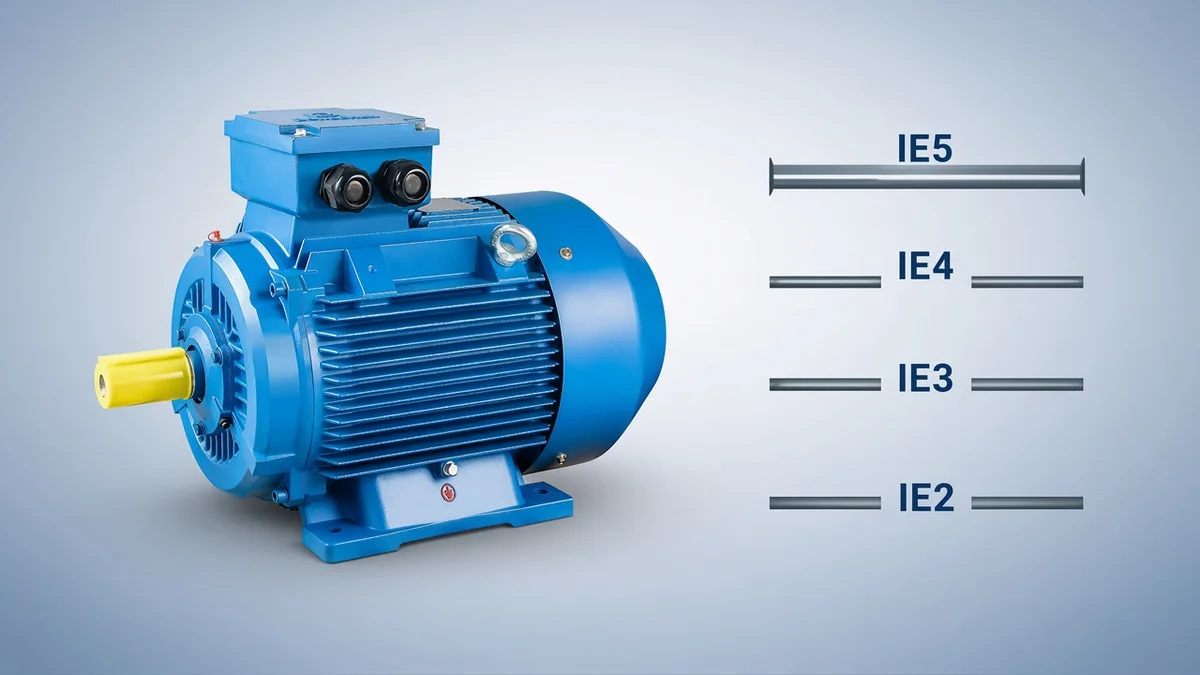
A catalog line that says “IE4 motor” looks decisive until you ask which standard edition, which frequency table, and whether the nameplate power/pole combination is inside the class document’s scope. Without that, IE labels are marketing vocabulary, not a selection rule.
IEC 60034-30-1 is the IE-code classification document for line-operated, single-speed AC motors. The 2025 edition covers motors rated for sinusoidal 50 Hz, 60 Hz, or both, in the 0.12~1000kW range with 2/4/6/8 poles, and it introduces IE5 alongside IE1–IE4 nominal limit tables for 50 Hz and 60 Hz. Classification and marking live in the efficiency clause set; buyers should treat the IE mark as a claim against those nominal limits — not as proof of field kWh savings on every load profile.
Scope signals buyers should read before trusting a class sticker
From the IEC 60034-30-1:2025 preview / contents structure (official webstore entry + sample document):
- The document addresses single-speed motors for direct-on-line sinusoidal supply (50 Hz and/or 60 Hz).
- It publishes separate nominal efficiency limit tables for IE1–IE5 at 50 Hz and 60 Hz.
- Preview notes that higher IE classes at small powers may need a larger frame than a legacy power–frame assignment, and that 60 Hz designs can show different efficiency headroom than 50 Hz for the same torque-related sizing logic.
- Certain constructions sit outside ordinary “test as a standard motor” assumptions — for example some integral brake builds and other special constructions called out in the standard’s scope notes. Always open the current edition’s Scope clause for the exact product you are buying; do not invent exclusions from memory.
| Claim on quote | What a verified IE class can support | What it does not prove by itself |
|---|---|---|
| “IE3” / “IE4” / “IE5” on brochure | Supplier intends the model to meet the named IE nominal limit for a stated PN / poles / frequency | That your hours, tariff, and part-load profile will pay back the price delta |
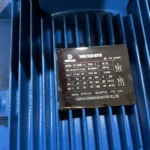
| Nameplate IE code | Marking claim for the rated point used for classification | Measured in-plant efficiency at your real load and ambient |
| “Meets IEC 60034-30-1” | Points to the IE-code framework | That the factory used the correct frequency table and latest edition limits |
| Dual 50/60 Hz listing | Dual-frequency marketing | That both frequencies were declared with the correct efficiency values and clear marking |
IE ladder at a glance (selection language, not invented % tables)
Use class language the way buyers and MEPS texts use it:
| Class (IE code) | Buyer-facing role | Typical RFQ use |
|---|---|---|
| IE2 | Baseline high-efficiency class still referenced in many MEPS bands for smaller powers | Confirm when destination law still allows or requires IE2 in a sub-band |
| IE3 | Premium / high-efficiency class widely used as MEPS for mid/large three-phase ranges | Default ask for continuous S1 pumps/fans when law or lifecycle justifies it |
| IE4 | Super-premium class; mandatory in a specific EU power/pole band from July 2023 | Required evidence band for many 75–200 kW EU shipments (see timeline below) |
| IE5 | Highest class introduced in IEC 60034-30-1:2025 | Spec only when payback, frame, starting, and inertia trade-offs are accepted in writing |
Do not treat “IE5” as automatically better procurement. Higher classes can mean more active material, different rotor designs, larger frames, different starting / inertia behavior, and a higher unit price that intermittent duty may never recover.
When does a higher IE class pay back — and when is it the wrong RFQ ask?
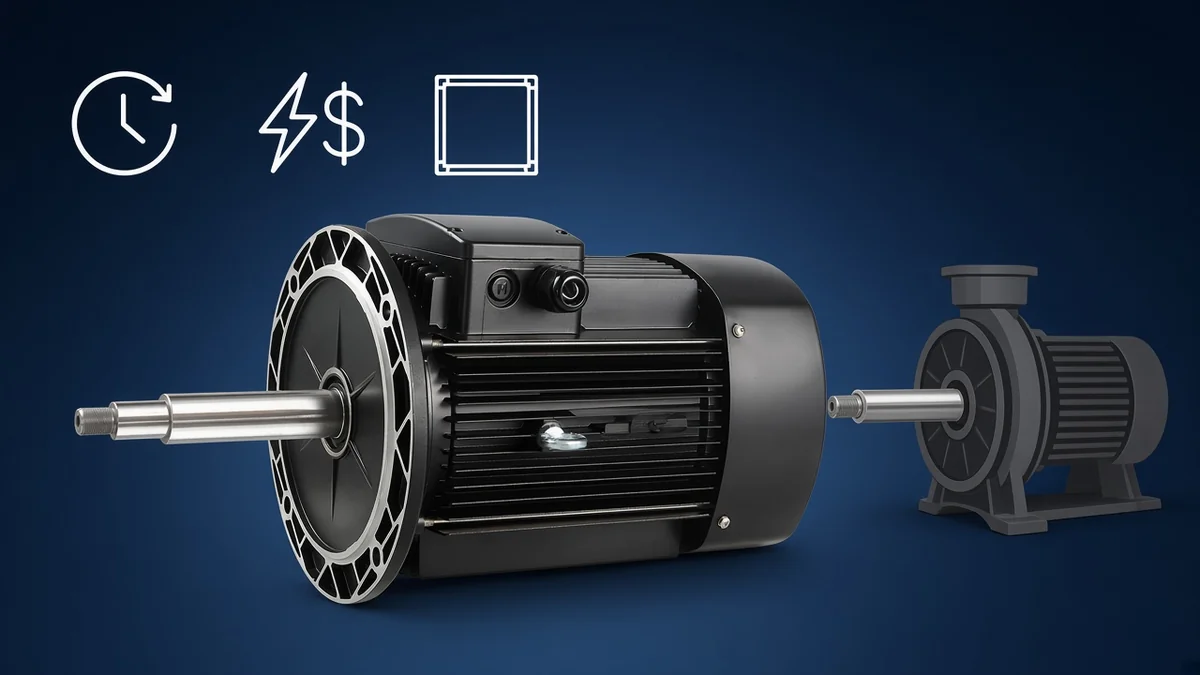
An OEM upgrades every motor on a skid to IE5 because the catalog looks future-proof. The machine runs 800 hours per year, starts often, and sits in a tight frame envelope. The energy saving never appears in the project IRR, but the mechanical redesign cost does. That is a selection failure, not an efficiency-class failure.
Higher IE pays when annual operating hours, electricity tariff, 그리고 load factor make loss reduction cash-positive — and when the mechanical package still fits. Intermittent duty, short campaigns, or severe starting constraints often justify staying at the legal minimum IE for the destination market rather than chasing the top sticker.
Practical selection checks (still without inventing kWh numbers)
- Hours first. Continuous process pumps and fans are the classic IE3/IE4 payback candidates; low-hour conveyors and standby machines often are not.
- Load factor. A motor that idles far below rated load may not deliver the brochure’s full-load efficiency story. Ask for rated efficiency at 100% / 75% / 50% load (EU information rules make this explicit for motors in scope — see below).
- Frame / starting / inertia. IEC 60034-30-1:2025 preview language warns that highest classes may need one frame size larger than a legacy assignment, especially at smaller powers. Put envelope and starting method into the RFQ before you compare IE4 vs IE5 prices.
- 50 Hz vs 60 Hz export messaging. Efficiency tables and marking differ by frequency. For dual-frequency nameplates, require a clear statement of which efficiency values apply at which frequency — do not accept a single IE stamp without frequency context.
| Buyer situation | Selection lean | RFQ evidence to demand |
|---|---|---|
| Continuous S1, high hours, EU destination | Meet or exceed the legal IE floor; consider IE4 where mandatory or where hours justify | Class + PN/poles/Hz + 100/75/50% efficiency disclosure |
| Intermittent / low hours | Legal minimum IE for destination; challenge IE5 cost | Duty type, hours/year, starting method, frame limit |
| Tight skid / replacement frame | Confirm frame growth risk before specifying IE4/IE5 | Outline drawing vs existing foundation / coupling |
| 50/60 Hz dual listing | Separate efficiency declarations | Nameplate + datasheet for each frequency |
For catalog browsing while you draft the RFQ, keep product paths such as /three-phase-motor/ 그리고 /ie3-series-electric-motor/ as line references — then lock the evidence pack below before price ranking.
What does EU Ecodesign Regulation (EU) 2019/1781 require, and on which dates?
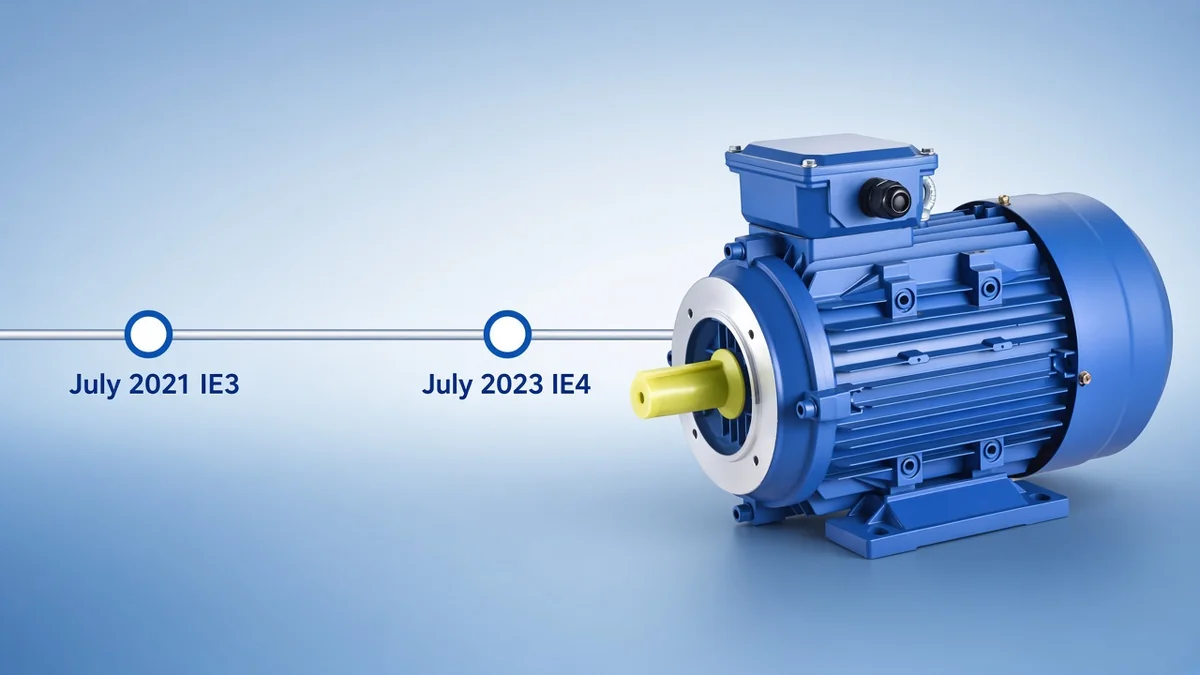
A shipment lands in Rotterdam with IE2 motors in a power band that has required IE3 since July 2021. The commercial team argues “the factory CE-marked it.” Ecodesign motor efficiency is not optional branding; for products in scope placed on the EU market, the regulation sets dated minimum IE levels by power, poles, and motor type.
Regulation (EU) 2019/1781 lays down ecodesign requirements for electric motors and variable speed drives. It applied from 1 July 2021, replacing the earlier motor regulation (EC) 640/2009. The European Commission’s electric-motors product page summarizes the same milestones buyers use in RFQs: IE3 for most three-phase motors from 0.75 kW to 1000 kW from July 2021, and IE4 for motors from 75 kW to 200 kW from July 2023 (with listed exclusions). Always re-open the Official Journal / consolidated text for the exact Annex wording before a compliance fight — links are in Sources.
Compliance timeline buyers can put on the RFQ cover sheet
Verified against Annex I energy-efficiency timetable language (OJ / consolidated text as mirrored in official HTML sources; see Sources) and the EC product page:
| From date | Who / what (high level) | Minimum IE (regulation language) |
|---|---|---|
| 1 July 2021 | Three-phase motors, rated output ≥ 0.75 kW and ≤ 1000 kW, 2/4/6/8 poles, not Ex eb increased-safety motors | At least IE3 |
| 1 July 2021 | Three-phase motors, rated output ≥ 0.12 kW and < 0.75 kW, 2/4/6/8 poles, not Ex eb | At least IE2 |
| 1 July 2023 | Ex eb increased-safety motors ≥ 0.12 kW and ≤ 1000 kW, 2/4/6/8 poles; and single-phase motors ≥ 0.12 kW | At least IE2 |
| 1 July 2023 | Three-phase motors that are not brake motors, not Ex eb, and not other explosion-protected motors, rated output ≥ 75 kW and ≤ 200 kW, 2/4/6 poles | At least IE4 |
Notes that belong in the RFQ, not in tribal knowledge:
- 그만큼 IE4 band is narrow: 75–200 kW, 2/4/6 poles, with brake / Ex eb / other explosion-protected motors carved out of that IE4 obligation (they follow the other rows / exclusions — verify case by case).
- 8-pole motors in the large three-phase band remain under the IE3 July 2021 rule in the timetable above; they are not in the July 2023 IE4 row.
- VSDs in scope have their own IE2 loss requirements from 1 July 2021 (separate from motor IE classes).
- Commission Regulation (EU) 2021/341 amended aspects of the 2019 package; cite the consolidated text when arguing edge cases.
In-scope vs out-of-scope (high level — open Annex / Article 2 for the live list)
The EC product page states that Regulation 2019/1781 applies to 1-phase and 3-phase induction motors with powers from 0.12 to 1000 kW, including special-purpose motors for explosive atmospheres, 8-pole motors and brake motors in the broadened scope narrative — while efficiency obligations and exemptions still depend on the detailed Article / Annex text.
Industry MEPS summaries (secondary; always verify against the legal text) commonly list exemption patterns such as:
- 모터 wholly immersed in a liquid
- 모터 completely integrated into a product so the energy performance cannot be tested independently
- Certain altitude / ambient / coolant extremes
- Some integral brake constructions and integrated motor+VSD compact drives that cannot be tested separately
- Certain nuclear 또는 mining ATEX special qualifications
Treat any exemption claim as an RFQ document request, not a verbal shortcut. If a supplier says “exempt,” ask which Article 2 point they rely on and how the spare-part / marking language will appear on the motor and paperwork.
| Statement | What official text / EC page can support | What it does not prove |
|---|---|---|
| “IE3 from July 2021 for 0.75–1000 kW three-phase” | Matches Annex timetable + EC summary | That a specific serial number was placed on the market after that date with matching DoC |
| “IE4 from July 2023 for 75–200 kW 2/4/6-pole” | Matches Annex timetable + EC summary | That brake / Ex variants are covered the same way |
| “CE marked” | Product may claim conformity under applicable EU legislation | Alone: that Ecodesign motor IE minima and information duties were met |
| “Out of scope / exempt” | Possible under listed exemptions | Validity without citing the exemption point and supporting design facts |
What information must EU-bound suppliers be able to show — and how does that differ from a CE logo?
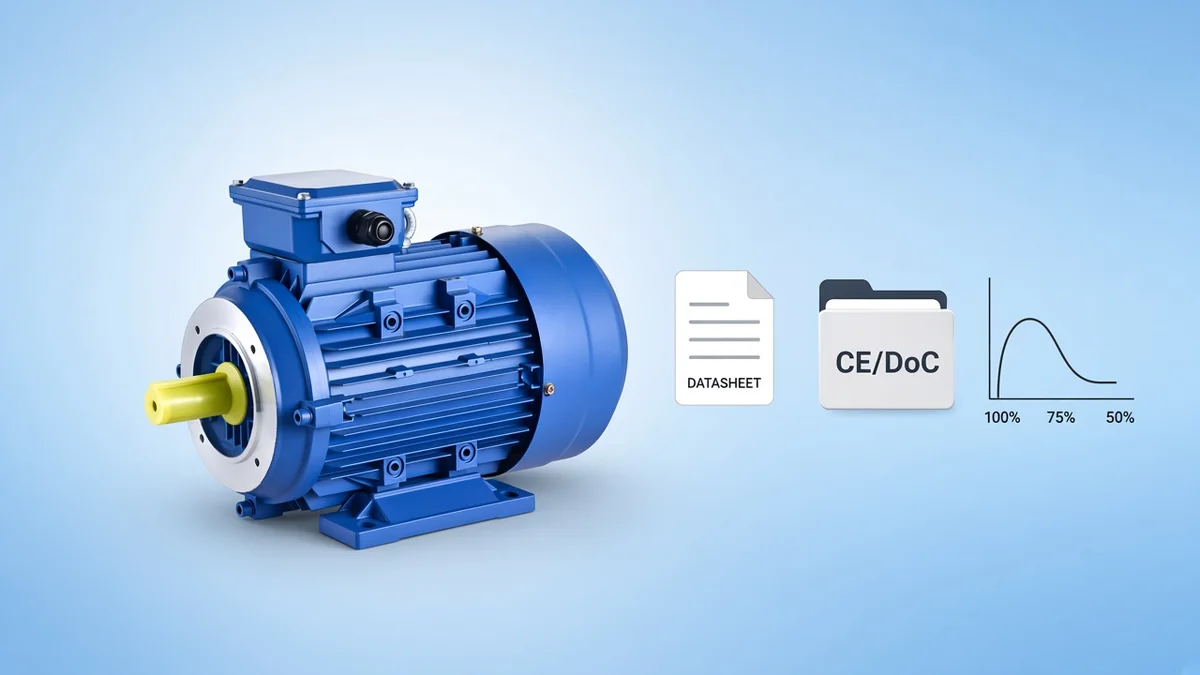
Buyers often accept a CE mark photo and a one-line “IE3” on the quote. For motors in scope, Annex I also sets product information duties: efficiency at full, 75%, and 50% rated load (from 1 July 2021), IE level, identification data, operating-condition ranges, and — from 1 July 2022 — additional speed–torque loss points. That package is what makes two EU quotations comparable.
Information buyers should demand in the RFQ (motors)
Aligned with Annex I product-information requirements (paraphrased for RFQ use; quote the Annex for contracts):
- Rated efficiency η ~에 100% / 75% / 50% rated load and rated voltage (50 Hz basis as required), to one decimal place.
- IE level (IE2 / IE3 / IE4 as determined under the regulation’s tables).
- Manufacturer identity, model identifier, poles, PN, frequency, voltage, speed, single- or three-phase.
- Operating condition ranges (altitude, ambient, coolant where relevant, explosive atmosphere notes).
- If claiming exemption: the specific reason.
- From the July 2022 information row: speed-versus-torque loss points listed in the Annex (or “N.A.” where not suited).
- Precautions for use with variable speed drives, when relevant.
CE / DoC vs Ecodesign — keep the folders separate in your head
| Folder | What it is for | Common buyer mistake |
|---|---|---|
| Ecodesign 2019/1781 | Minimum IE levels + information / VSD rules for products in scope placed on the EU market | Treating “CE” as proof of the correct IE band |
| CE marking / EU Declaration of Conformity | Manufacturer’s conformity claim across applicable Union legislation | Accepting a CE logo JPEG without a DoC that lists the motor regulation |
| Technical documentation | File that should support the DoC and Ecodesign declarations | Never requesting it even for first-article or high-kW shipments |
| IEC 60034-30-1 IE class | Classification / marking framework used by datasheets and many MEPS texts | Assuming IE5 is already an EU MEPS obligation (it is not, under the 2019/1781 timetable above) |
A usable EU RFQ sentence: *“Quote must state the IE level required under Regulation (EU) 2019/1781 for this PN/poles/type, attach η at 100/75/50% load, and include a DoC that lists the applicable ecodesign regulation. If exempt, cite the Article 2 point.”*
Why rising material costs make “claimed IE” a procurement risk
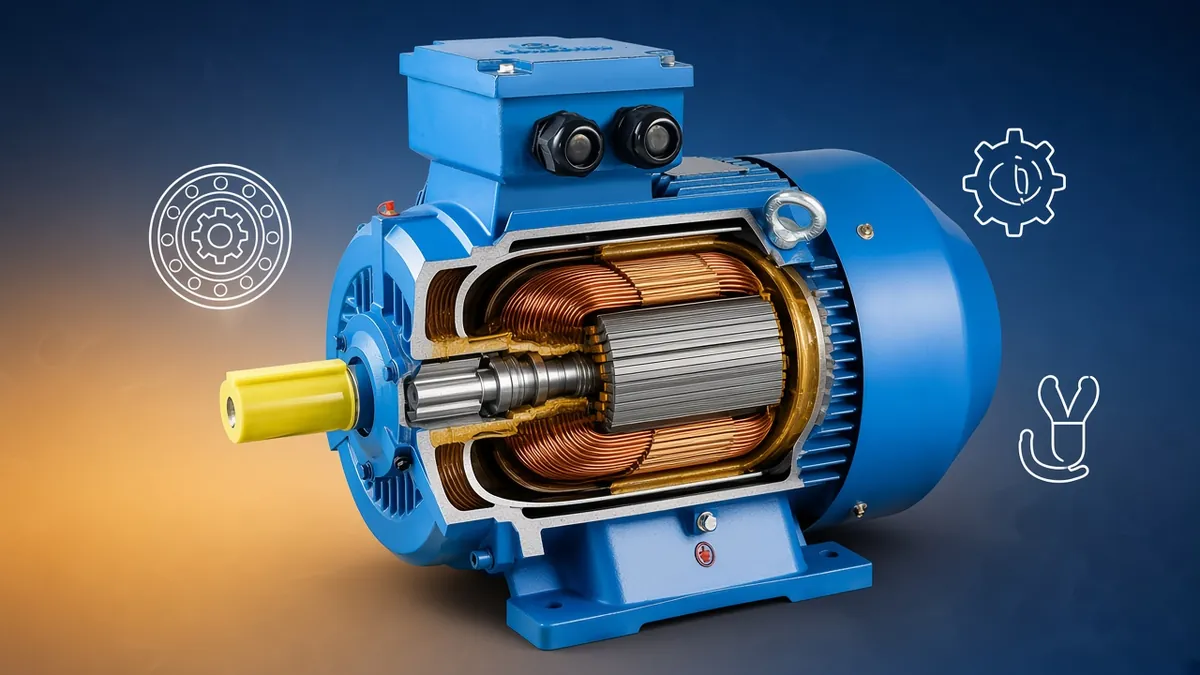
Copper, electrical steel, insulation systems, and bearing packages move with commodity and supply-chain cycles. When factories are pressured on price, a quiet downgrade path is familiar to export buyers: thinner or lower-grade magnetic steel, reduced copper section or aluminum substitution without redesign disclosure, cheaper impregnation, or bearing brand swaps after sample approval. The brochure still says IE3 or IE4. The shipped motor may no longer support that claim in a proper efficiency test.
This is not a claim that any named factory always cheats. It is a procurement control: if your RFQ only ranks unit price, you have selected for the downgrade path.
Rated / calculated / measured — ask which number is on the table
Borrow the honesty language buyers need whenever efficiency is sold hard:
| Number type | What it usually means in RFQ talk | Buyer control |
|---|---|---|
| Rated / declared | Value the supplier puts on the nameplate / offer as the rating claim | Require it to meet the IE table for PN/poles/Hz |
| Calculated / design | Engineering estimate from design tools or loss models | Ask for method boundaries; do not treat as a witnessed test |
| Measured / test | Result from a defined test method / report | Ask for method (e.g. IEC 60034-2-1 family as applicable), load points, and whether the serial or a type sample was tested |
If a quote only says “IE4” with no η values, no frequency, and no test/method note, it is not yet an IE4 purchase — it is a slogan.
Material evidence checklist (attach to every IE-sensitive RFQ)
- Electrical steel: grade / thickness family stated for the quoted design (not only “high-grade silicon steel” marketing).
- Winding: copper vs aluminum; wire size policy; whether any substitution needs written approval.
- Insulation / impregnation: thermal class and process description relevant to the claimed temperature rise.
- 문장: brand / type on the quote annex; change-control rule after FAT or sample approval.
- Efficiency evidence: rated η at 100/75/50%; which values are calculated vs measured; test standard named.
- Change control: written rule that material or process changes affecting losses require re-approval before mass shipment.
| Risk signal | What to require before price ranking | What a low price alone proves |
|---|---|---|
| IE claim far below market without design story | Material annex + efficiency test/method note | Nothing about sustained IE capability |
| Sample approved, bulk later cheaper | Lock bill-of-materials / bearing / steel notes into the PO | That bulk equals sample |
| “Equivalent IE4” wording | Exact IE code + PN/poles/Hz + η table | Marketing equivalence |
| EU destination + thin DoC | DoC listing 2019/1781 + information pack | That CE art equals Ecodesign data |
Dongchun Motor publishes IE-class product lines for export storytelling on iecmotores.com; use those pages to align model families, then still run the evidence pack above on the live quotation — soft catalog fit is not a substitute for RFQ proof.
How should buyers structure unresolved IE / Ecodesign checks in the RFQ?
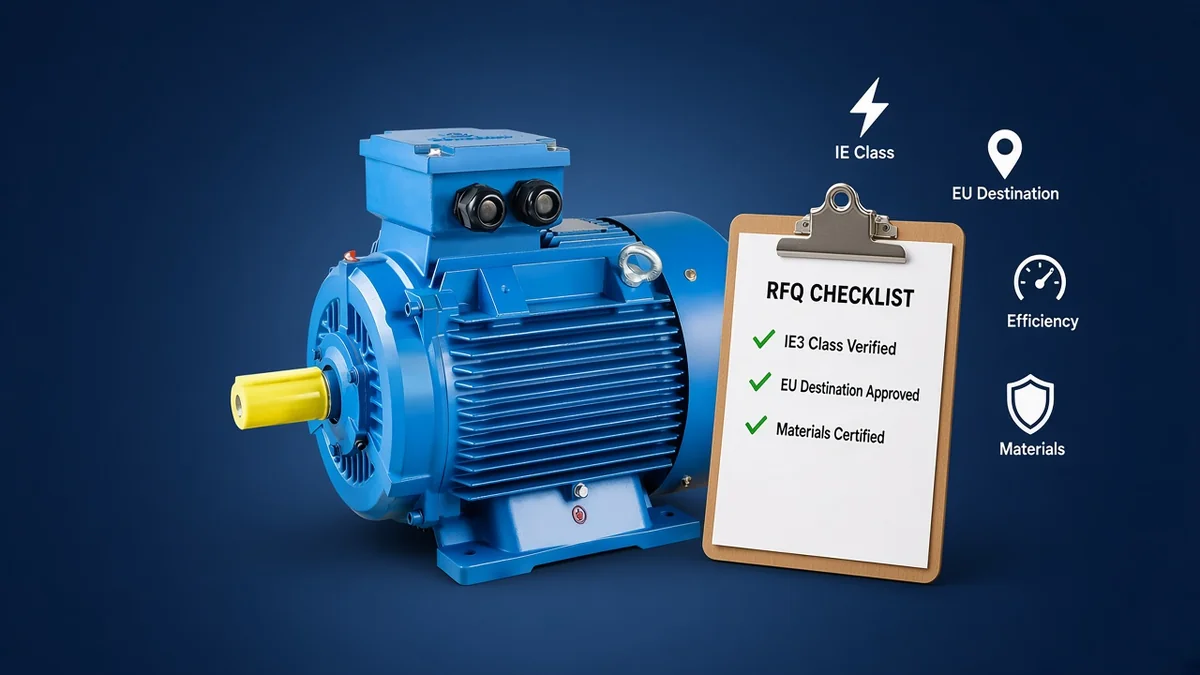
Two quotations with the same kW are still incomparable if one assumes IE3 @ 50 Hz continuous duty and the other assumes an exempt brake motor at 60 Hz. Put unresolved checks into the RFQ so price cells mean the same thing.
Unresolved check → RFQ question
| Unresolved check | Required RFQ question |
|---|---|
| Destination law unclear | “Is the destination EU/EEA (or which MEPS market)? State the minimum IE you will supply under Regulation (EU) 2019/1781 or the named local MEPS.” |
| Power/pole band ambiguous | “Confirm PN (kW), poles, brake yes/no, Ex protection type if any, and whether the July 2023 IE4 row applies.” |
| Frequency unclear | “Provide IE class and rated efficiencies for the quoted frequency (50 Hz / 60 Hz / both). Dual-frequency: list both.” |
| Efficiency evidence missing | “Provide η at 100% / 75% / 50% load. Mark each value as rated/declared, calculated, or measured; name the test method if measured.” |
| Information pack incomplete | “Attach the Annex I information items you will place on the datasheet / rating plate / website for this model.” |
| Exemption claimed | “Cite the exact Article 2 exemption point and the marking/documentation text you will use.” |
| Material downgrade risk | “List electrical steel grade family, winding metal, insulation thermal class, and bearing brand/type. Confirm written approval is required before any substitution.” |
| Frame / starting risk on IE4/IE5 | “State frame size vs IEC 60072-1 assignment expectations, and any starting / inertia limits for this design.” |
| DoC / CE folder thin | “Provide a DoC that lists Regulation (EU) 2019/1781 (or state why not applicable) plus the technical file index you can show on request.” |
One-page RFQ cover block (copy/paste)
- Destination market / Incoterm / placement-on-market party responsible for Ecodesign conformity.
- PN, poles, duty type, hours/year, supply frequency, brake / Ex notes.
- Required minimum IE class under destination law (and any project preference above the floor).
- Required η at 100/75/50% + IE code on nameplate.
- Material + bearing annex + change-control sentence.
- DoC / information-pack attachments list.
- Only after the above: unit price and lead time comparison.
FAQ
Is IE5 already mandatory under EU 2019/1781?
No. The Annex timetable verified for this article mandates up to IE4 in a defined 75–200 kW, 2/4/6-pole band from 1 July 2023, with IE2/IE3 obligations in other rows. IE5 is an IEC 60034-30-1:2025 efficiency class available for product design and voluntary specification — not an automatic EU MEPS floor in that regulation’s timetable.
Does a CE mark prove the motor meets the IE3 or IE4 date rules?
Not by itself. CE marking is a conformity claim across applicable legislation. For motor efficiency, buyers should look for a 의사 that references the ecodesign motor regulation and for the IE level + efficiency information the Annex requires. A logo photo without that folder is incomplete evidence.
Can I compare a 50 Hz IE3 quote with a 60 Hz IE3 quote on price alone?
Not safely. IEC 60034-30-1 publishes separate 50 Hz and 60 Hz nominal limit tables, and dual-frequency machines need clear declarations. Normalize frequency, PN, poles, and duty before ranking price.
When should an importer still ask for IE2?
When destination law still sets IE2 as the minimum in a power band (for example the EU 0.12–<0.75 kW three-phase row from July 2021, or Ex eb / single-phase IE2 rows from July 2023), or when a non-EU MEPS still references IE2. “Still legal” is not the same as “best lifecycle choice” for high-hour machines.
What if the supplier says the motor is exempt?
Ask for the specific exemption point, the design facts that trigger it, and the marking / documentation text. Exemptions are narrow; “special motor” as a sales phrase is not evidence.
Should OEM buyers always specify IE4 or IE5 to be safe?
Specify at least the legal floor for the destination. Above the floor, decide with hours, tariff, frame, starting, and verified efficiency evidence. Over-specifying IE5 without envelope and payback checks can create mechanical and cost problems without compliance benefit.
결론
IE class stickers and EU dates only help if the RFQ makes them operational. Use IEC 60034-30-1 to understand what IE2–IE5 mean for line-operated single-speed motors — including frame and 50/60 Hz realities — and use Regulation (EU) 2019/1781’s July 2021 / July 2023 timetable to set the legal floor for EU-bound power and pole bands. Then refuse price-only comparisons: demand η at multiple load points, clarify rated vs calculated vs measured, and lock material and bearing evidence so a claimed IE class can still hold when raw-material costs push factories to cut corners.
If you are aligning model families while you draft that evidence pack, start from the public 삼상 모터 그리고 IE3 시리즈 paths on iecmotores.com, then send the unresolved-check table above with your inquiry.
Sources
Primary / official (re-checked for this draft; EUR-Lex HTML endpoints returned WAF/403 to automated fetch — timetable language verified via Official Journal HTML mirrors and EC page; re-open EUR-Lex in a browser before legal reliance):
- European Commission — Electric motors product page (scope narrative; IE3 from July 2021; IE4 from July 2023 for some categories; VSD IE2; information requirements): https://energy-efficient-products.ec.europa.eu/product-list/electric-motors_en
- Regulation (EU) 2019/1781 — EUR-Lex OJ ELI: https://eur-lex.europa.eu/eli/reg/2019/1781/oj/eng
- Regulation (EU) 2019/1781 — consolidated 2023-01-24 ELI: https://eur-lex.europa.eu/eli/reg/2019/1781/2023-01-24/eng
- Regulation (EU) 2019/1781 — CELEX HTML: https://eur-lex.europa.eu/legal-content/EN/TXT/HTML/?uri=CELEX:32019R1781
- UK legislation.gov.uk plain-view Annex I (official retained EU law HTML used to verify timetable / information requirements wording when EUR-Lex WAF-blocked automated clients): https://www.legislation.gov.uk/eur/2019/1781/annex/I/adopted?view=plain
- IEC 60034-30-1:2025 webstore entry (IE classes; IE5 introduced; 0.12–1000 kW line-operated single-speed scope pointer): https://webstore.iec.ch/en/publication/91195
- IEC 60034-30-1:2025 sample/preview PDF (contents; IE5 tables noted; frame-size and 50/60 Hz nuance in introduction/scope notes): https://cdn.standards.iteh.ai/samples/iec/iec-60034-30-1-2025/bb23bcce3ee644a88a05cd039737e713/iec-60034-30-1-2025.pdf
Secondary (industry overview — verify against local law / OJ text):
- ABB — Minimum Efficiency Performance Standards for electric motors (Sept 2026 industry overview; EU MEPS slide summary): https://library.e.abb.com/public/1f170a279f154f128cc3f02f47ae7e11/MEPS%20for%20electric%20motors%2009-2026.pdf
Research pack pointers (internal to DC-2026-1012; not public citations): by-topic/T04.md, by-topic/T05.md, topics/04-ie2-ie5-efficiency-classes.md, OUTLINE-HANDOFF.md.
(待补) if a later revision needs them: full EUR-Lex browser capture of Annex I tables pasted as controlled excerpts; LatAm national MEPS official links beyond Chile (T11); anonymized buyer threads questioning IE5 claims; speed–torque loss grid sample for T18 follow-up.