Lo scorso marzo, un acquirente di Lagos mi ha inviato un messaggio su WhatsApp alle 2 di notte: "Metà del mio contenitore di motori 'IE3' non supera il test a vuoto. Cosa devo fare?" Aveva pagato il 18% in più rispetto al fornitore economico e si era comunque scottato. Gestisco una fabbrica di motori a Taizhou, in Cina, e ricevo la stessa chiamata quasi ogni mese. Quindi ecco esattamente come dico agli acquirenti di scegliere un vero fornitore di motori cinese, senza scottarsi.
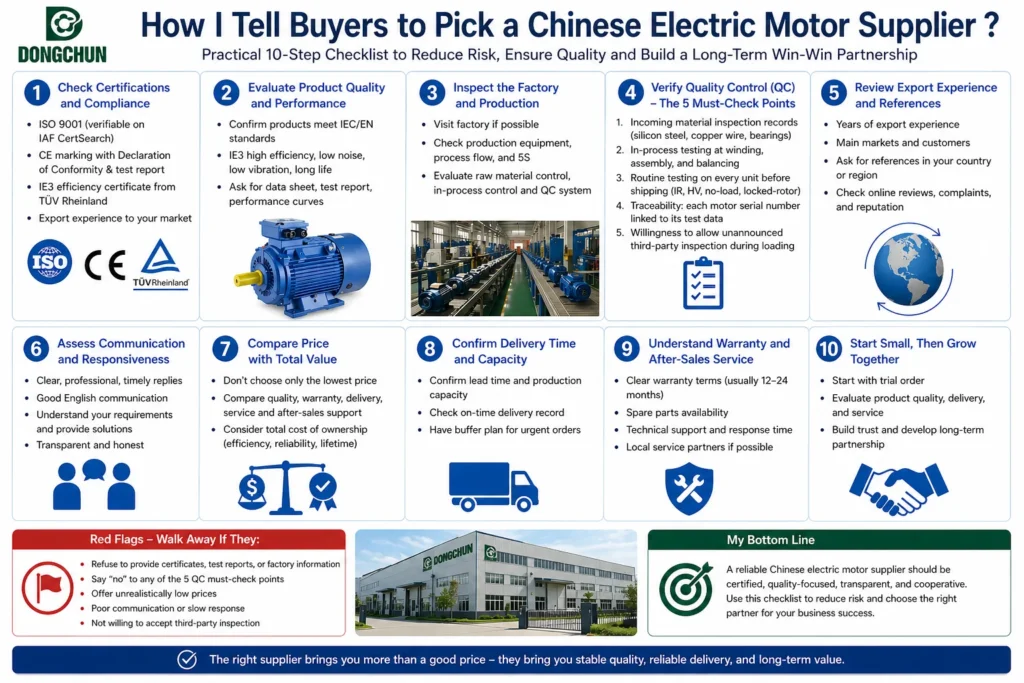
Per scegliere un fornitore di motori cinese di cui ti puoi fidare, controlla sette cose: (1) numeri di certificato IE3 verificati dal TUV che puoi trovare su Certipedia, (2) almeno 10 anni di esperienza reale in fabbrica, (3) test di routine su ogni motore (isolamento, alta potenza, senza carico, rotore bloccato), (4) un track record di consegna di 30 giorni, (5) disponibilità a consentire l'ispezione di terze parti durante il caricamento, (6) un contatto WhatsApp nominato che risponda entro 24 ore e (7) Storia OEM/ODM con clienti di riferimento. Inizia sempre con un piccolo ordine di prova prima di impegnarti con un contenitore pieno.
Ti guiderò attraverso ognuno di questi nello stesso modo in cui li accompagno ai nuovi acquirenti durante una videochiamata.
Perché così tanti acquirenti hanno problemi con i fornitori di motori cinesi?
Prima di dirti come sceglierne uno buono, lascia che ti spieghi perché la maggior parte degli acquirenti si fa male.
I problemi più comuni che vedo sono: divari di qualità tra campione e massa (esca e cambio), certificati falsi o esagerati, consegna che slitta oltre i 45 giorni senza preavviso, rappresentanti di vendita che tacciono dopo lo sbarco del deposito e zero supporto tecnico dopo le motonavi. Meno del 30% delle fabbriche automobilistiche cinesi di piccole e medie dimensioni riesce a produrre costantemente IE3 o superiore. Questo singolo numero è il motivo per cui la selezione del fornitore conta più del prezzo.
China's electric motor industry has annual output above 800 billion yuan, with thousands of factories ranging from a 10-person workshop to a real OEM with a stamping line. That spread is exactly why due diligence matters.
Il divario di qualità tra campione e massa
This is the number one complaint I hear. The sample is perfect — right efficiency, smooth paint, proper nameplate. The container arrives and the motors are different: rougher finish, different bearing brand, hotter operating temperature, efficiency numbers that do not match the test report.
Why? Some factories build samples in a "showcase" cella con materiali di prima qualità, quindi effettua ordini all'ingrosso su una linea separata con componenti più economici. I soliti scambi:
Cuscinetti più economici (cinese C&U invece di NSK o SKF)
Avvolgimenti in alluminio anziché in rame o rame più sottile
Laminazioni in acciaio al silicio di qualità inferiore
Isolamento in classe B invece che in classe F
Pareti dell'alloggiamento in ghisa più sottili
Lo scorso settembre un acquirente di Quito mi ha chiamato su WhatsApp. Aveva ordinato 60 motori IE3 trifase da 7,5 kW da un'altra fabbrica nello Zhejiang. I campioni erano perfetti. Il contenitore? Cuscinetti diversi: cinese C&U invece di NSK. Tre motori si sono bruciati nel primo mese nel suo negozio di pompe. Ci ha trasmesso il suo prossimo ordine di 4 poli. La prima cosa che ha chiesto è stata "posso vedere le fatture portanti del vostro fornitore?" SÌ. Gli ho inviato la fattura NSK lo stesso giorno e il rapporto di equilibratura del rotore (grado G2.5) il giorno successivo.
Interruzioni della comunicazione
Molti acquirenti mi raccontano la stessa storia: la comunicazione era ottima prima dell'ordine, poi i tempi di risposta sono crollati. Le domande sull'avanzamento della produzione, sulla spedizione o sulle specifiche tecniche sono rimaste senza risposta per giorni. Ciò di solito significa che il team di vendita è distaccato dal reparto o che la fabbrica sta impegnando eccessivamente la propria capacità per troppi clienti contemporaneamente.
Il problema della certificazione
Sarò onesto con te: tra il 10% e il 30% dei certificati che vedi sui PDF dei fornitori cinesi sono falsi o fuorvianti. Per i motori, le due zone pericolose sono dichiarazioni di efficienza IE3 senza veri test TUV e dichiarazioni CE senza rapporto di test di supporto. Dal 2019, [IE3 è stato il minimo legale in tutta l'UE](https://link.springer.com/chapter/10.1007/978-3-030-69799-0_16)1 per motori industriali a bassa tensione da 0,75 kW a 375 kW, con regole simili in Brasile, Messico e Corea. Se il tuo fornitore non è in grado di mostrare un vero rapporto di prova con timbro TUV, stai esaminando i blocchi doganali prima ancora di raggiungere l'acquirente.
Per ulteriori informazioni sull'individuazione dei certificati falsi, consulta la nostra guida interna sui suggerimenti per la verifica dei certificati dei motori (ne parlerò in un articolo successivo).
Meno del 30% dei produttori di motori cinesi di piccole e medie dimensioni è in grado di produrre costantemente motori con efficienza IE3 o superiore su larga scala.VERO
L'analisi del settore automobilistico cinese mostra che, sebbene la produzione totale superi gli 800 miliardi di yuan all'anno, solo i produttori con investimenti significativi in acciaio al silicio premium (50W470 o superiore), avvolgimenti in rame ad alta purezza, bilanciamento di precisione del rotore (grado G2.5) e test completi possono raggiungere in modo affidabile IE3. La maggior parte delle piccole officine non dispone delle attrezzature e dei materiali necessari per farlo in modo coerente.
Tutte le fabbriche automobilistiche cinesi utilizzano le stesse materie prime e gli stessi processi, quindi la differenza di qualità è principalmente nell'etichetta del marchio.Falso
La variazione di qualità tra i produttori di automobili cinesi è enorme. Differenze nella qualità dell'acciaio al silicio, nella purezza del rame, nella marca dei cuscinetti (NSK/SKF vs C&U), insulation class (B vs F vs H), rotor balancing precision, and routine testing create big performance gaps. A 4-pole 5.5kW motor from a premium factory can run 15-20 years; a similar-looking budget motor often fails inside 3-5 years.
Quali certificazioni dovrebbe avere un fornitore di motori cinese?
Certificates are the most objective filter you have — but only if they are real.
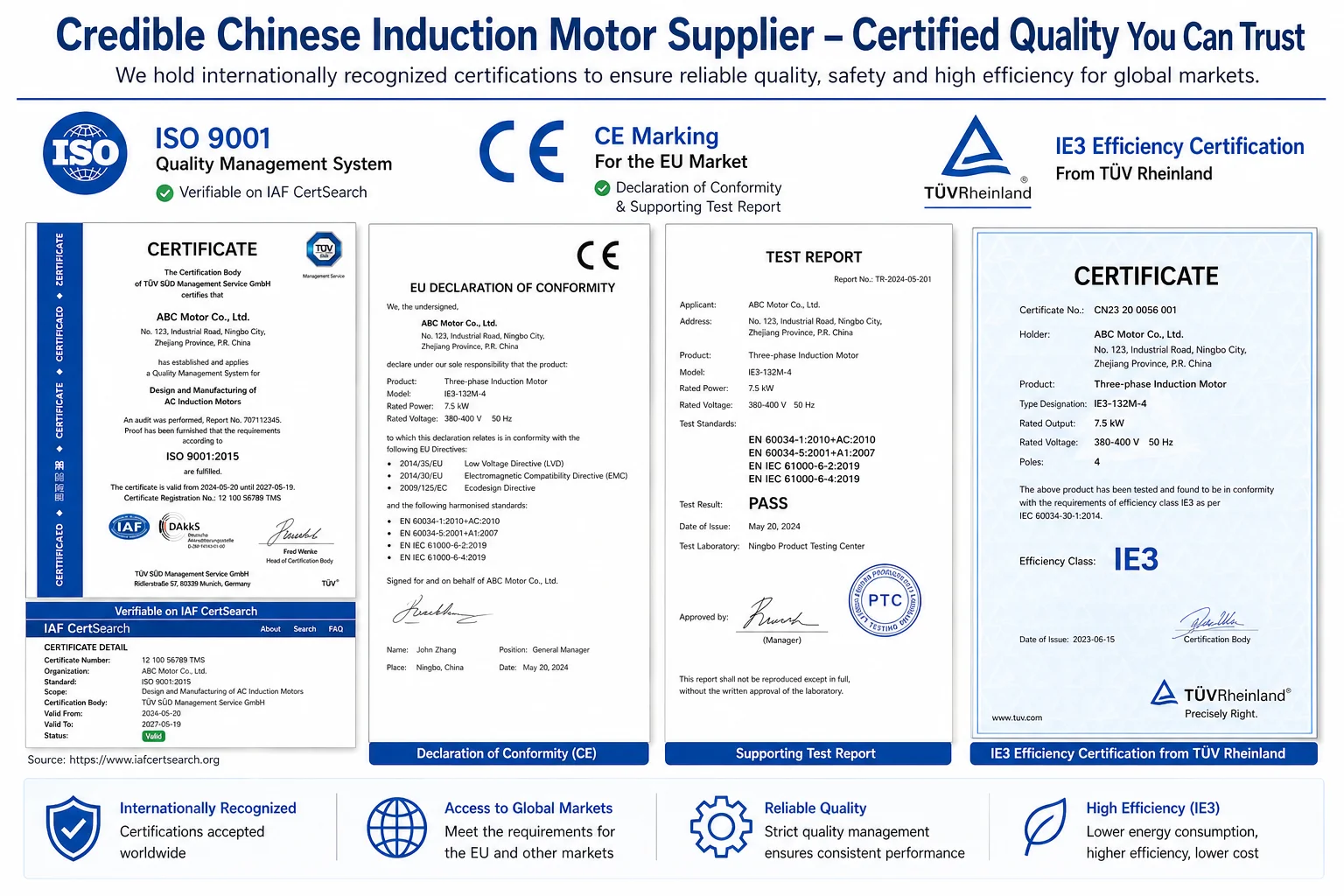
A credible Chinese motor supplier should hold ISO 9001 (verifiable on IAF CertSearch), CE marking with a Declaration of Conformity and supporting test report for the EU market, and IE3 efficiency certification from TUV Rheinland, TUV SUD, SGS, or Bureau Veritas. For extra confidence, ask for CCC for the China domestic market and IECEE CB scheme certificates for international acceptance. Always verify the certificate number on the issuer's database, not on the supplier's PDF.
Not every certificate carries the same weight. Here is how I tell buyers to prioritize.
Matrice delle priorità di certificazione
Certificazione
Cosa dimostra
How to Verify
Priorità
ISO9001
Esiste un sistema di gestione della qualità
Ricerca Certificazione IAF
Essenziale
Marcatura CE
Conforme alle direttive di sicurezza dell'UE
Richiedi DoC + rapporto di prova
Essential for EU
IE3 dal TUV
Efficiency independently tested
Certipedia or TUV SUD Certificate Finder
Alto
CCC
Meets China mandatory standards
Banca dati del CNCA
Buon segnale
CB dell'IECEE
Risultati dei test accettati in oltre 50 paesi
Banca dati dei certificati CB
Useful for multi-market
ATEX
Sicuro per atmosfere esplosive
Verifica dell'Organismo Notificato
If you sell to oil and gas
Come utilizzare le certificazioni durante la valutazione dei fornitori
Do not just ask "do you have CE certification?" — every supplier will say yes. I tell every new buyer the same thing: ask for the specific certificate number, then go check it yourself. Five steps:
Ask for the exact certificate number
Verify it on the issuing body's database
Confirm the scope covers the exact motor models you need (a YE3 4-pole 5.5kW cert does not cover a YE3 2-pole 11kW)
Check the certificate is current, not expired
Confirm the manufacturer name on the cert matches the legal entity you are wiring money to
When I hand a buyer my cert numbers and tell them to verify on Certipedia, that is me showing I have nothing to hide. If a competitor gets nervous when you ask, that is your answer.
Il vantaggio TUV
Among third-party motor efficiency certifications, TUV (Rheinland, SUD, or NORD) carries the most weight. A TUV-verified IE3 certificate means real motor samples went to a TUV lab, tests followed IEC 60034-30-1, efficiency was independently measured (not self-declared), and the certificate is publicly checkable on[the TUV certificate database](https://www.certipedia.com/)2. This is a much higher bar than a self-signed CE mark or a certificate from an unknown lab.
A TUV-verified IE3 efficiency certificate means physical motor samples were tested in TUV laboratories per IEC 60034-30-1, and the result is publicly searchable on Certipedia or the TUV SUD Certificate Finder.VERO
TUV certification for motor efficiency requires the manufacturer to send physical samples to a TUV testing facility. Engineers run efficiency tests using the IEC 60034-30-1 method, and the results are published in publicly accessible databases. This gives an independent, verifiable record buyers can check in two minutes.
A CE marking on a Chinese motor means a European certification body has tested and approved it before export.Falso
CE marking is a manufacturer self-declaration of conformity with EU directives, not an approval issued by a European body. The manufacturer signs the Declaration of Conformity and applies the CE mark itself. Under the Low Voltage Directive, third-party testing is not legally required for standard industrial motors, so many Chinese motors carry CE marks with no independent test behind them.
Come si valuta il controllo di qualità di una fabbrica di motori?
Certificates tell you about the system on paper. A factory tour tells you about daily practice.
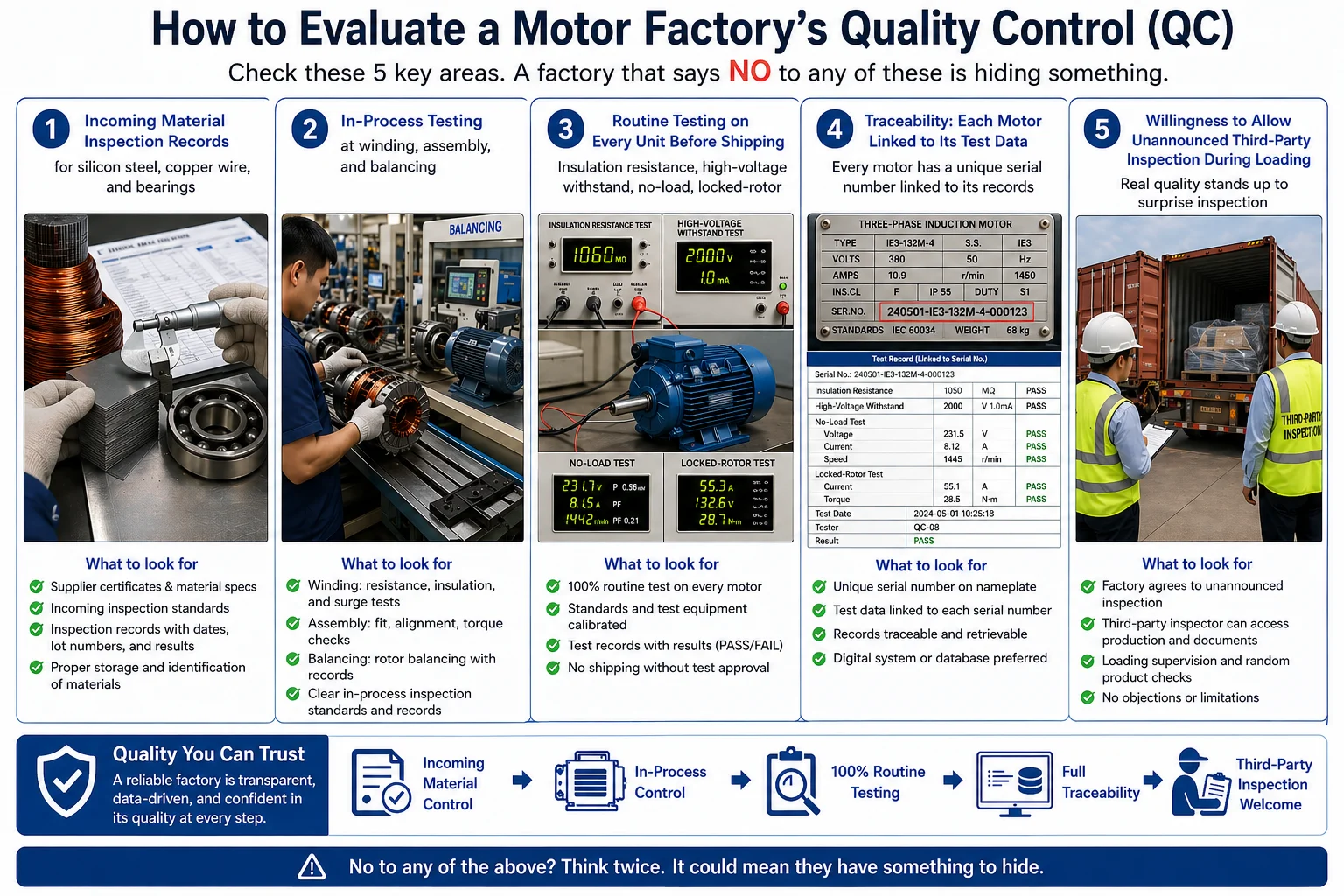
Evaluate a motor factory's QC by checking five things: (1) incoming material inspection records for silicon steel, copper wire, and bearings, (2) in-process testing at winding, assembly, and balancing, (3) routine testing on every unit before shipping (insulation resistance, high-voltage withstand, no-load, locked-rotor), (4) traceability linking each motor serial to its test data, and (5) willingness to allow unannounced third-party inspection during loading. A factory that says no to any of these is hiding something.
A factory tour — in person or on video call — tells you more about quality commitment than any certificate. Last month I walked an Athens-based pump distributor through our line on a 40-minute video call. He asked for the rotor balancing G-grade reading on three random motors, and we showed him the live readout on the dynamic balancer. He placed a 200-unit B5 4-pole 1.5kW order the next week.
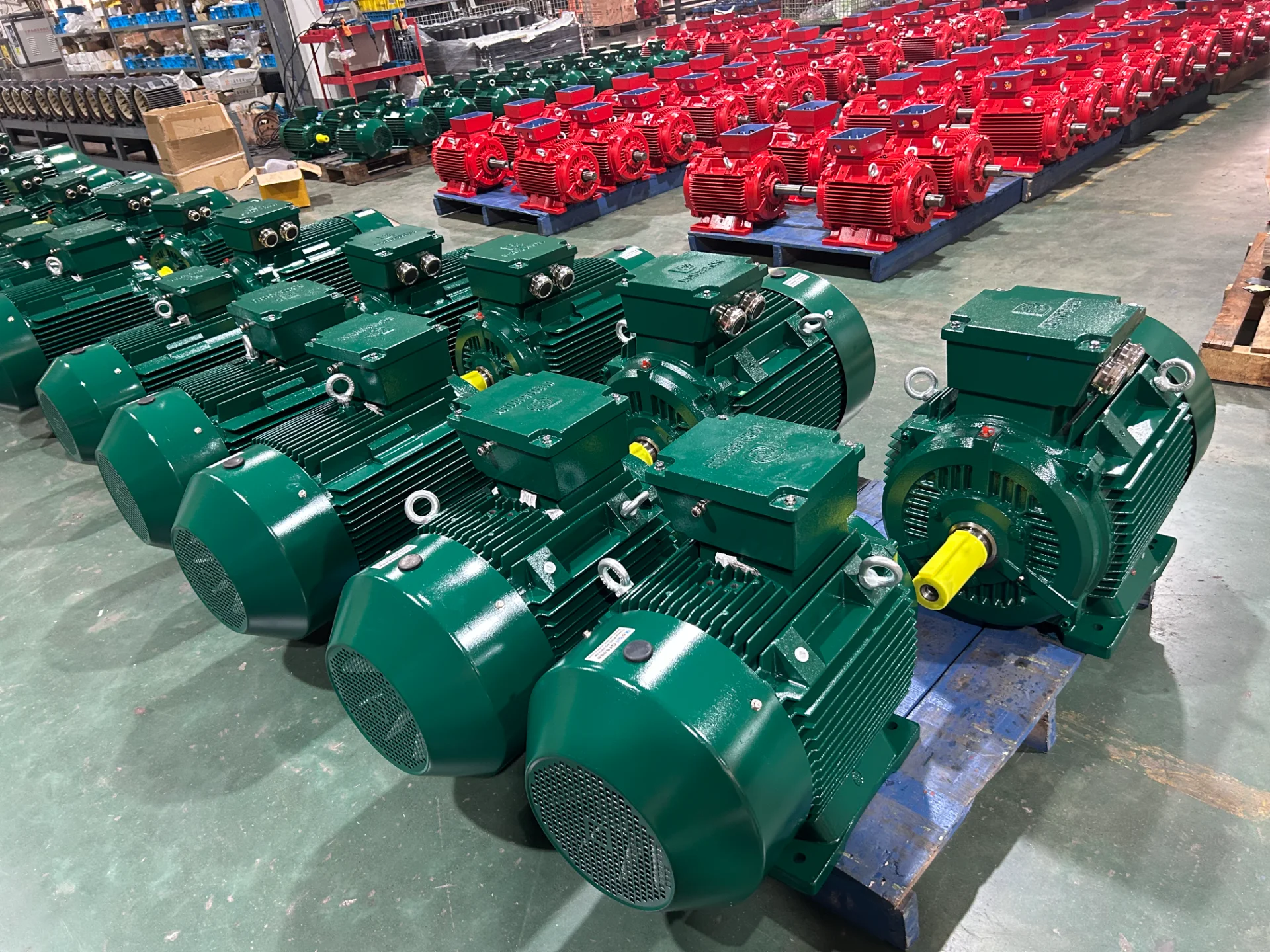
Punti chiave di controllo della qualità nella produzione di motori
Fase di produzione
Cosa controllare
Bandiera Rossa
Materie prime
Incoming inspection records, supplier certs for steel and copper
No records, unknown brands
Avvolgimento statorico
Wire tension, fill factor measurement
Avvolgimento manuale senza controllo del processo
Bilanciamento del rotore
Dynamic balancer, G2.5 or G1.0 grade
No balancer visible on the floor
Assemblea
Bearing pressing tools, alignment measurement
Cuscinetti montati sul martello
Paint and finish
Paint thickness gauge, adhesion test
Drips, rust spots, uneven coating
Collaudo finale
Ogni unità testata, dati registrati
Solo test su campioni, nessuna conservazione dei dati
Il protocollo di prova finale
A serious motor factory runs all of these on every single motor before it ships:
Prova di resistenza d'isolamento— verifies winding insulation, minimum 100 Megohms
High-voltage withstand test (hi-pot)— applies 2x rated voltage + 1000V for one minute to find insulation defects
Prova a vuoto— measures current and power at rated voltage with no mechanical load, verifies mechanical assembly
Prova a rotore bloccato— measures starting current and torque
Prova di vibrazione— confirms rotor balance and bearing condition
Ask the supplier directly: "do you test every motor, or do you sample test?" Factories that test every unit are investing real money — the test bench alone costs USD 50,000 to USD 200,000 per line, and it adds 15-30 minutes of labor per motor. Factories that sample test are saving cash and shipping you the risk.
Ispezione di terze parti
For any container above USD 20,000, hire SGS, Bureau Veritas, or Asia Inspection to inspect during loading. It costs roughly USD 300-500 per man-day. On a USD 40,000 container, that is a 1% insurance premium. Always book the inspection during the loading phase — that way the inspector watches the actual motors going into the container, not a pre-selected showcase batch staged in a different warehouse.
For more on choosing the right efficiency class, see our IE3 vs IE2 comparison (I'll publish a dedicated post on this soon).
A complete routine motor test protocol per IEC 60034-1 includes insulation resistance, high-voltage withstand, no-load, and locked-rotor tests on every unit before shipping.VERO
These four tests are the internationally recognized minimum for electric motor quality assurance, specified in IEC 60034-1 as routine tests. They verify insulation integrity, dielectric strength, mechanical assembly quality, and starting performance. Reputable manufacturers run all four on 100% of production, not just samples — and record the data against the motor serial.
If a motor passes the factory final test, it is guaranteed to perform correctly for its full rated lifespan.Falso
Factory final tests verify the motor is correctly built and free of defects at shipping. They do not predict long-term reliability, which depends on operating conditions, maintenance, ambient temperature, and material quality over years. A motor can pass every factory test and still fail early if the silicon steel grade is substandard, the insulation class is wrong for the operating temperature, or the bearings are budget grade.
Quali standard di consegna e comunicazione dovresti aspettarti?
Consegne affidabili e comunicazioni chiare separano gli esportatori professionali dalle fabbriche che accettano ordini che non possono soddisfare.
For standard IEC motor orders, expect 25-35 days lead time for a 1x20ft container of stock models, and 40-60 days for custom specs (special voltage, mounting, paint, or OEM brand). A serious supplier will give you a production schedule within 48 hours of order confirmation, weekly progress photos, and proactive delay notification. Routine response time should be under 24 hours, and under 4 hours for urgent production issues.
Delivery is where most supplier relationships break. Getting realistic timelines and clear communication protocols in writing prevents most disputes.
Aspettative realistiche in termini di tempi di consegna
Tipo di ordine
Tempi di consegna tipici
Appunti
Stock models, standard 400V/50Hz
20-30 giorni
If factory keeps key components in inventory
Standard range, made-to-order
30-45 giorni
Normal cycle for non-stock IEC motors
Custom voltage (e.g. 440V/60Hz for Peru)
35-50 giorni
Requires winding redesign
Custom paint and OEM branding
30-40 giorni
Aggiunge 3-7 giorni per l'indurimento della vernice
Non-standard mounting (B5/B14/B35)
40-60 giorni
May need flange casting modifications
OEM completamente personalizzato
60-90 giorni
Tooling, prototype, sample approval
A Bangkok food machinery buyer last quarter wanted 80 motors at 380V/50Hz B3-mounted IE3 4-pole 4kW — stock spec for me. We loaded the container on day 28. He told me his previous supplier had quoted 45 days and slipped to 70.
Migliori pratiche di comunicazione
Before your first order, lock these in writing:
Contatto primario— named person, direct WhatsApp number
Contatto di riserva— second person who handles urgent issues
Aggiorna il programma— how often you get production progress photos
Percorso di escalation— who you contact if the primary contact disappears
Linguaggio della documentazione— confirm all technical docs come in English (or your language)
A factory that agrees to these and sticks to them is investing in the relationship, not just the transaction.
Garanzia e supporto post-vendita
Industry standard warranty is 12-18 months. A factory offering a 24-month warranty is signaling confidence in the build. When you check warranty terms, ask:
Does it cover replacement only, or also shipping back to China?
What is the claims process — photos and video, or do you have to ship the motor back?
Is on-site technical support available for big orders or recurring issues?
Can the factory send you motor maintenance guides in your language?
Need a sample to verify before you commit? Most factories charge for it. We do not, on the first 1-2 units to qualified B2B buyers.
A 25-35 day production lead time for a 1x20ft container of stock IEC motors from an established Chinese factory is realistic and achievable.VERO
For factories with efficient supply chains and component inventory, 25-35 days is achievable for standard IEC motors. The cycle breaks down as material prep (5-7 days), winding and assembly (10-15 days), painting and routine testing (5-7 days), and packing and loading (3-5 days). Factories quoting much shorter than this are usually cutting corners on testing or paint curing.
The cheapest motor supplier always has the worst quality, so you should always pick the most expensive option to be safe.Falso
Price and quality are not perfectly linear in the motor industry. Some mid-priced factories deliver excellent quality because they have efficient operations and lower overhead. Some expensive suppliers charge premium prices for middleman margins, not better motors. The right approach is to evaluate quality independently — verify certificates, audit QC, test samples, check references — then compare prices among the suppliers that pass the gate.
Come Dongchun risolve questi 7 problemi
After all the diligence, here is how Dongchun (iecmotores.com) specifically answers the seven problems I just walked through. I built this table for one buyer in Santiago last month — he asked me to map his pain points to my actual answers, and that is what is below.
Dongchun is a low-voltage motor specialist covering single-phase ML/MY/YC/YCL series (0.09-7.5kW) and three-phase IE1 through IE5 (0.09-315kW), in 2-pole through 8-pole, IP55 standard, Class F insulation, B3/B5/B14/B35 mounting. Our IE3 cert is TUV-verified and searchable on Certipedia. Standard delivery is 30 days for a 1x20ft container. Warranty is 2 years — a year longer than the industry standard. Full customization on voltage (220-690V, 50/60Hz), mounting, paint color, and OEM nameplate.
Problem-to-Answer Map
Common Problem
Dongchun's Specific Answer
Sample vs bulk quality gap
One production line — same NSK bearings, same 50W470 silicon steel, same Class F insulation in samples and bulk. I send the bearing supplier invoice on request.
Fake certificates
TUV-issued IE3 cert with the cert number on it. Search it yourself on Certipedia in 60 seconds.
Delivery slipping past 45 days
Standard 30-day delivery on 1x20ft container of stock IEC models. Weekly photos with date stamps from day 7.
Sales team going silent
Named WhatsApp contact, 24-hour response on routine, 4-hour on urgent. My direct line is on the PI.
Lack of technical support
English maintenance guides, sizing help by WhatsApp, video troubleshooting on bearing or winding issues.
2-year warranty (industry is 12-18 months). Photo/video claim process — you do not need to ship motors back to China.
Customers Who Have Tested This
A pump distributor in Lima placed three repeat orders for IE3 4-pole 7.5kW after his first 50-unit trial passed his own bench test
An Athens machinery group switched from a Zhejiang factory to us after their previous 200-unit lot failed hi-pot at the customer site
A Lagos industrial buyer ran our motors against a budget Chinese brand on the same pump duty — ours were still running 14 months later, the budget brand had failed in the first 4 months
A South Africa OEM uses our YE3 series at 525V 50Hz with their own nameplate, 100-unit monthly cadence
Dongchun Motor's IE3 efficiency certification is issued by TUV and can be independently verified through publicly accessible TUV certificate databases such as Certipedia.VERO
Dongchun holds IE3 efficiency certification verified by TUV and documented in TUV's official certificate databases. Buyers can search the certificate number on Certipedia and confirm it is current and covers the specific motor model. This third-party verification distinguishes us from suppliers who only self-declare efficiency claims.
Dongchun è il più grande produttore di motori elettrici in Cina e produce più motori di qualsiasi altra fabbrica cinese.Falso
Dongchun is a specialized low-voltage IEC motor manufacturer focused on quality consistency and customization for international B2B buyers — not the largest by volume. China has very large producers like WEG China, TECO, and Wolong with much higher production volumes. Our edge is in quality consistency, customization, and reliable service, not raw output.
Domande frequenti
How long does it take to ship a container of motors from China?
For stock IEC models, a 1x20ft container typically loads at 25-35 days from order confirmation, plus shipping time (around 30-40 days to South America, 25-35 days to West Africa, 15-25 days to Mediterranean Europe). Custom voltage or OEM branding adds another 10-20 days.
How do I check if a Chinese motor's IE3 certificate is real?
Ask the supplier for the exact certificate number, then search it directly on Certipedia (TUV Rheinland) or the TUV SUD Certificate Finder. If it is not in the database, the certificate is fake. This takes two minutes and saves you from a USD 40,000 mistake.
Should I do a third-party inspection before shipping?
On any container above USD 20,000, yes. SGS, Bureau Veritas, or Asia Inspection cost USD 300-500 per man-day — that is roughly 1% of the order value. Always book the inspection during loading so the inspector watches the actual motors go into the container.
What is a normal MOQ for Chinese motor factories?
For stock items, 1 carton (around 20 motors) is common. For OEM nameplate or custom spec runs, expect 50-100 units minimum. Anything below that and most factories will not bother with the tooling or paperwork.
Can a Chinese factory ship 60Hz motors to Brazil, Peru, or Ecuador?
Yes — but confirm two things in writing. First, the factory has done the winding redesign for 60Hz (it is not the same motor as 50Hz with a different label). Second, the TUV IE3 certificate scope covers the 60Hz version, not just 50Hz. Many factories trip on this second point.
Conclusione
Picking a Chinese motor supplier comes down to four things I tell every buyer: verify the certs yourself on Certipedia, audit QC by video or in person, lock delivery terms in writing, and start with a small trial order. That is the whole game.
Parla con me
Send me a list of motor models and target market — I will come back with the matching IE class, TUV cert numbers, and a 30-day delivery date. Reach me through ourContattacipage and I will respond the same day.
IE3 efficiency mandate— If you are shipping motors to the EU, Brazil, Mexico, or Korea, you legally cannot bring in non-IE3 low-voltage industrial motors. This source tells you which markets enforce it and from when, so you can avoid your container getting stuck at customs.
Domanda Google suggerita:IE3 mandatory countries low voltage motor regulation
TUV certificate database— Do not take a supplier's PDF at face value. Type the cert number into Certipedia yourself. If it is not there, the certificate is fake. Two minutes of checking saves you from a five-figure mistake.
Domanda Google suggerita:Certipedia TUV motor IE3 certificate verification
This Springer chapter explains exactly when IE3 became the legal minimum across the EU, Brazil, Mexico, and Korea, with the kW ranges and dates you need to avoid customs blocks.↩
Certipedia is TUV Rheinland's public certificate search. Type the certificate number from your supplier's PDF — if it is not there, the certificate is fake. Two minutes of checking saves a USD 40,000 mistake.↩