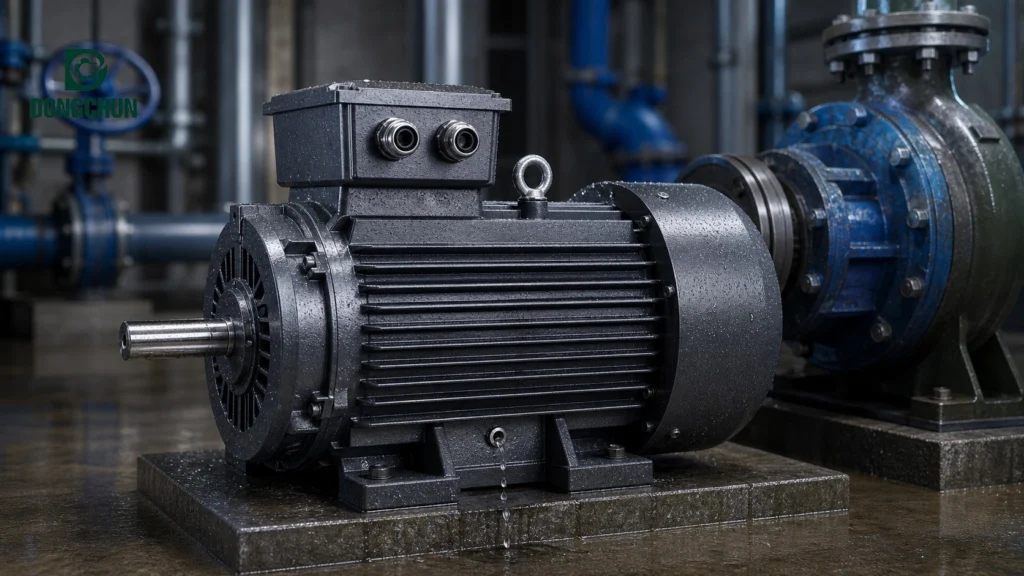
Un trou de vidange moteur n’est pas un défaut de coulée ou un point faible à boucher aveuglément. Il s'agit d'une petite fonction de contrôle de l'humidité qui permet à l'eau condensée de quitter le moteur à induction avant qu'elle n'endommage l'isolation des enroulements, les roulements, les pièces terminales et les surfaces métalliques internes.
Je traite cela comme un signal de douleur de l'acheteur, et non comme un petit article détaillé sur le produit.
La plainte commence généralement par une simple photo : un client voit un petit trou près du bas du châssis d'un moteur électrique et demande si l'usine a oublié de le fermer. Parfois, l'utilisateur peint dessus ou le scelle avec du silicone parce que le trou semble dangereux. Plus tard, le même moteur peut présenter une faible résistance d'isolation, des bruits de roulement, des marques de corrosion ou une plainte de défaut à la terre après un stockage humide ou un service extérieur.
For the buyer in Chile, that is not a theory problem. If he imports motors for pumps, gearboxes, reducers, agricultural machines, cooling towers, or mining equipment, a misunderstood drain hole can turn into a warranty argument with the final user. The buyer thought he improved protection. In reality, he may have trapped condensation inside the motor.
La règle d'achat est simple : comprenez le chemin de vidange avant de juger du prix, de la qualité IP ou de la garantie.
Traitez le trou de vidange du moteur comme une preuve de la demande de prix et non comme un défaut.
Un trou de vidange du moteur est une ouverture placée au point bas du châssis du moteur, du bouclier d'extrémité ou de la zone de boîtier associée afin que l'eau condensée puisse quitter le moteur. Selon la conception, il peut apparaître sous la forme d'un petit trou ouvert, d'un trou fileté avec un bouchon fileté, d'un bouchon de vidange en caoutchouc, d'un bouchon scellable en plastique ou d'un drain de reniflard.
Sur de nombreux moteurs basse tension CEI, cette fonctionnalité est intentionnelle. Les instructions relatives aux moteurs basse tension ABB comprennent une section pour les machines équipées de bouchons de vidange pour la condensation et indiquent que les trous et les bouchons de vidange doivent être orientés vers le bas.[1] Les instructions manuelles WEG traitent également les bouchons de vidange comme des éléments normaux d'installation et de maintenance, avec des instructions différentes en fonction du degré de protection et du niveau de condensation.[3]
Cela signifie que l’acheteur ne doit pas approuver ou rejeter le moteur sur la seule base de son apparence. La question utile de la RFQ est :
Où se trouve le point de vidange sur le moteur cité et comment manipuler le bouchon de vidange une fois la position de montage finale confirmée ?
Pour un moteur de pompe, un moteur de ventilateur, un moteur VFD, un moteur de frein ou un moteur à induction triphasé général, cela appartient au même ensemble de preuves que le montage, la position de la boîte à bornes, la qualité IP, le presse-étoupe et l'environnement d'application.
✓
Un trou de vidange du moteur doit être vérifié dans le cadre de l’ensemble des preuves de la demande de prix et non traité automatiquement comme un défaut. Vrai
Use this check to confirm the quoted motor matches the application before deposit.
×
Si un acheteur voit un petit trou près du bas du châssis d’un moteur à induction, l’action la plus sûre est toujours de le sceller de façon permanente. FAUX
Treat missing proof as a purchasing risk until the supplier confirms it in writing.
Demandez pourquoi de la condensation se formera avant de demander si le trou doit être scellé
L'eau à l'intérieur d'un moteur électrique ne signifie pas toujours que la pluie est entrée par un couvercle cassé. Dans de nombreuses applications réelles, l’humidité provient de la condensation.
Un moteur à induction chauffe pendant le fonctionnement et refroidit après l'arrêt. Si l’air ambiant est humide, l’humidité peut se condenser sur les surfaces internes plus froides. Les instructions d'utilisation de Siemens décrivent les risques de condensation liés aux fluctuations de la température ambiante, à la lumière directe du soleil, à une humidité de stockage élevée, au fonctionnement intermittent et aux variations de charge.[4]
C'est pourquoi je ralentis lorsqu'un acheteur dit que le moteur fonctionnera dans :
Régions côtières.
Salles des pompes.
Sites miniers.
Usines de traitement des eaux usées.
Fermes aquacoles.
Zones des tours de refroidissement.
Machines agricoles d'extérieur.
Stock d'entrepôt de longue attente.
Le trou d'évacuation n'empêche pas la formation de condensation. Il donne à l’eau accumulée un chemin contrôlé vers l’extérieur. Si l’acheteur ignore l’environnement d’exploitation, la décision de vidange devient une conjecture.
✓
Le trou de vidange n'empêche pas la condensation du moteur ; il aide l'humidité accumulée à quitter l'enceinte après la formation de condensation. Vrai
Use this check to confirm the quoted motor matches the application before deposit.
×
Si un moteur électrique possède un indice IP, la condensation ne peut plus se former à l'intérieur du moteur. FAUX
Treat missing proof as a purchasing risk until the supplier confirms it in writing.
Vérifiez le chemin de la défaillance avant d'accepter une réclamation relative à l'humidité.
Lorsque de l’eau reste à l’intérieur du moteur, la panne peut ne pas apparaître immédiatement. Le premier avertissement peut être une lecture faible du mégohmmètre, un courant de fuite, un déclenchement intempestif, un bruit de roulement, de la rouille dans la boîte à bornes ou une panne de moteur peu de temps après l'installation.
L'humidité peut réduire la résistance d'isolation des enroulements. Les directives de Siemens préviennent que l'enroulement du stator humide réduit la résistance d'isolation et peut entraîner un contournement qui détruit l'enroulement.[4] L'humidité peut également contaminer la graisse, corroder les surfaces des roulements et favoriser la rouille sur le matériel interne, les tôles, les connexions des bornes et les pièces du rotor.
Je ne diagnostique pas chaque panne de moteur comme un problème de trou de vidange. Les dommages aux roulements peuvent provenir de la tension de la courroie, d'un désalignement, de vibrations, d'une surcharge, d'une mauvaise lubrification ou de dommages causés par le transport. Une panne électrique peut provenir de la tension, de la phase, de la surcharge, du câblage, des paramètres du VFD ou d'une mauvaise protection. Mais lorsqu'un moteur fonctionne en service humide et que le chemin de vidange a été bloqué, repeint ou mal positionné, la condensation doit être étudiée avant que la discussion sur la garantie ne devienne émotionnelle.
For the buyer's resale business, this matters because the cost is not only one motor. It is freight, technician time, customer trust, and project delay.
✓
L'humidité laissée à l'intérieur d'un moteur électrique peut réduire la résistance d'isolation et contribuer à la corrosion des roulements, à la contamination par la graisse, à la rouille interne ou au risque de défaut à la terre. Vrai
Use this check to confirm the quoted motor matches the application before deposit.
×
Si un moteur tombe en panne dans une application humide, le trou de vidange prouve que l'usine est à l'origine de la panne. FAUX
Treat missing proof as a purchasing risk until the supplier confirms it in writing.
Adaptez la manipulation du bouchon de vidange à la position de montage et à l'état IP
La mauvaise question est : « Tous les trous de vidange du moteur doivent-ils être ouverts ou fermés ?"
La question utile est la suivante : dans cette installation, avec ce degré IP et cet état du site, qu'exige le manuel du moteur ?
Les directives ABB indiquent que les trous de drainage et les bouchons doivent être orientés vers le bas, et que les environnements très poussiéreux peuvent nécessiter la fermeture des trous de drainage.[1] Les directives WEG séparent la pratique IP55 des degrés de protection plus élevés tels que IP56, IP65 et IP66, où les bouchons de vidange peuvent devoir rester fermés pendant le fonctionnement et être ouverts uniquement pendant la maintenance.[3]
La position de montage change la décision. Le montage sur pied B3, le montage sur bride B5, le montage sur bride sur pied B35, le montage vertical V1 et le montage vertical V3 ne placent pas toujours le même point de vidange à la position la plus basse. Les instructions Siemens indiquent également que les trous d'évacuation de l'eau dépendent du type d'installation et que les bouchons doivent être retirés régulièrement pour évacuer la condensation, puis remplacés.[5]
Pour un acheteur, la demande de prix doit indiquer :
Position de montage définitive.
Conditions intérieures, extérieures, humides, poussiéreuses ou lavables.
Exigence de qualité IP.
Position de la boîte à bornes et plan des presse-étoupes.
Que le bouchon de vidange soit ouvert, fermé, de type reniflard ou ouvert pendant la maintenance.
✓
La manipulation du bouchon de vidange doit être adaptée au manuel du moteur, à l'état IP, à l'exposition à la poussière ou au lavage et à l'orientation de montage finale. Vrai
Use this check to confirm the quoted motor matches the application before deposit.
×
Un acheteur peut décider des trous de drainage selon une règle universelle : toujours ouverts dans les sites humides et toujours fermés dans les sites secs. FAUX
Treat missing proof as a purchasing risk until the supplier confirms it in writing.
Décidez si les trous de drainage et les radiateurs anti-condensation doivent fonctionner ensemble.
Les trous de drainage et les radiateurs anti-condensation résolvent différentes parties du problème d’humidité.
Un trou de vidange ou un bouchon de vidange permet à l'eau accumulée de quitter le moteur. Un drain de reniflard peut permettre l’évacuation de l’humidité tout en limitant l’entrée des contaminants. Un chauffage anti-condensation ou un chauffage d'appoint maintient la zone d'enroulement plus chaude pendant l'arrêt et réduit le risque de condensation. Un test de résistance d'isolation montre si l'enroulement est suffisamment sec avant le démarrage, mais il s'agit d'un test et non d'une conception de drainage.
De nombreux moteurs industriels utilisent plusieurs méthodes. Un moteur de pompe près de l'eau, un moteur de ventilateur près d'une tour de refroidissement, un moteur minier exposé à un stockage humide ou un moteur VFD en attente d'une mise en service retardée peuvent nécessiter à la fois un plan de vidange et un contrôle de l'humidité de secours.
Je mettrais cette ligne dans la demande de prix :
Veuillez confirmer la recommandation de contrôle de l'humidité pour ce moteur dans les conditions indiquées sur le site : manipulation du bouchon de vidange, exigences de stockage, exigences de chauffage le cas échéant et vérification de la résistance d'isolation avant le démarrage.
Cette phrase est plus utile que de demander uniquement le « meilleur prix du moteur IP55 »."
✓
Les trous de drainage, les purges d'air, les réchauffeurs anti-condensation et les contrôles de résistance d'isolation sont des contrôles différents et peuvent devoir fonctionner ensemble en service humide ou en veille. Vrai
Use this check to confirm the quoted motor matches the application before deposit.
×
Si un moteur est équipé d'un chauffage anti-condensation, les instructions concernant l'orifice de vidange et le bouchon de vidange n'ont plus d'importance. FAUX
Treat missing proof as a purchasing risk until the supplier confirms it in writing.
Utilisez d'abord une liste de contrôle avant d'acheter des moteurs pour un service humide
Lorsque nous discutons d'un moteur pour une entreprise de pompes, une usine de machines, un acheteur de boîtes de vitesses, un acheteur de ventilateurs ou un distributeur, je ne veux pas que l'appel d'offres s'arrête au kW, au châssis et au prix. C’est nécessaire, mais cela ne suffit pas.
For the buyer's type of import business, I would ask every supplier for this moisture-risk evidence before comparing offers:
Type de moteur : moteur monophasé, moteur triphasé, moteur de frein, moteur VFD, moteur de ventilateur ou moteur de pompe.
Montage : B3, B5, B35, V1, V3 ou autre orientation confirmée.
État du site : intérieur, extérieur, côtier, tropical, exploitation minière, aquaculture, tour de refroidissement, lavage ou longue veille.
Degré IP et disposition boîte à bornes/presse-étoupe.
Position du trou de vidange ou du bouchon de vidange après l'installation.
Instruction d'ouverture, de fermeture, de reniflard ou d'ouverture de maintenance.
Instructions de stockage avant l'installation.
Si un chauffage anti-condensation ou un contrôle de la résistance d'isolation est nécessaire.
Photos avant expédition montrant la boîte à bornes, la plaque signalétique, le montage, la zone de vidange et l'emballage.
Dongchun Motor can be one China factory option when a buyer wants this kind of proof before order confirmation. I do not want the buyer to choose us only because the first number looks lower. I want him to compare suppliers after the motor condition, site condition, and moisture-control evidence are visible.
La commande est simple : prouvez d’abord le chemin de vidange, puis comparez le prix du moteur.
✓
Un appel d'offres axé sur la preuve rend les offres de moteurs à service humide plus comparables, car chaque fournisseur doit définir le montage, l'état IP, la manipulation des bouchons de vidange, le stockage et les preuves de contrôle de l'humidité. Vrai
Use this check to confirm the quoted motor matches the application before deposit.
×
La meilleure méthode d'achat consiste à choisir d'abord le moteur à induction le moins cher et à poser des questions sur les trous de drainage, le stockage, l'état IP et la condensation uniquement après l'apparition d'une plainte sur le terrain. FAUX
Treat missing proof as a purchasing risk until the supplier confirms it in writing.
Notes de bas de page
[1] ABB, Manuel « Moteurs basse tension », extrait de section pour les machines équipées de bouchons de vidange pour la condensation : https://library.e.abb.com/public/70a30c0d0999feacc1257dd90035cf07/LVStdMotorsManual_EN_01_2009.pdf
[2] Manuel d'installation, d'exploitation, de maintenance et de sécurité des moteurs basse tension ABB Chine, extrait de la table des matières montrant la section 4.8 pour les moteurs avec bouchons de vidange pour la condensation : https://motorswechat.abb.com.cn/motor/upload/manual/M3BP_M3AA_说明书-202206.pdf
[3] Miroir manuel d'utilisation de WEG Electric Motors, bouchon de vidange, guidage ouvert/fermé par niveau de condensation et degré IP : https://manualzz.com/doc/6046511/weg-electric-motors-user-manual
[4] Mode d'emploi du moteur à induction triphasé Siemens 1PL622, avertissement d'eau de condensation et d'enroulement humide : https://cache.industry.siemens.com/dl/files/379/34681379/att_93054/v1/1PL622_BE_0308_en.pdf
[5] Mode d'emploi du moteur à induction triphasé Siemens 1PH728, trous d'évacuation d'eau et instructions d'entretien des bouchons : https://cache.industry.siemens.com/dl/files/786/28711786/att_104999/v1/1PH728_BE_0308_en.pdf
[6] Extrait du manuel du moteur à induction Caterpillar sur les bouchons de vidange et l'eau de condensation : https://emc.cat.com/pubdirect.ashx?media_string_id=LEBW0049-
[7] Miroir de guidage de référence du moteur à induction TECO-Westinghouse, trous de drainage TEFC et drains de reniflard : https://oliointeriors.com/rf60eb_i.html