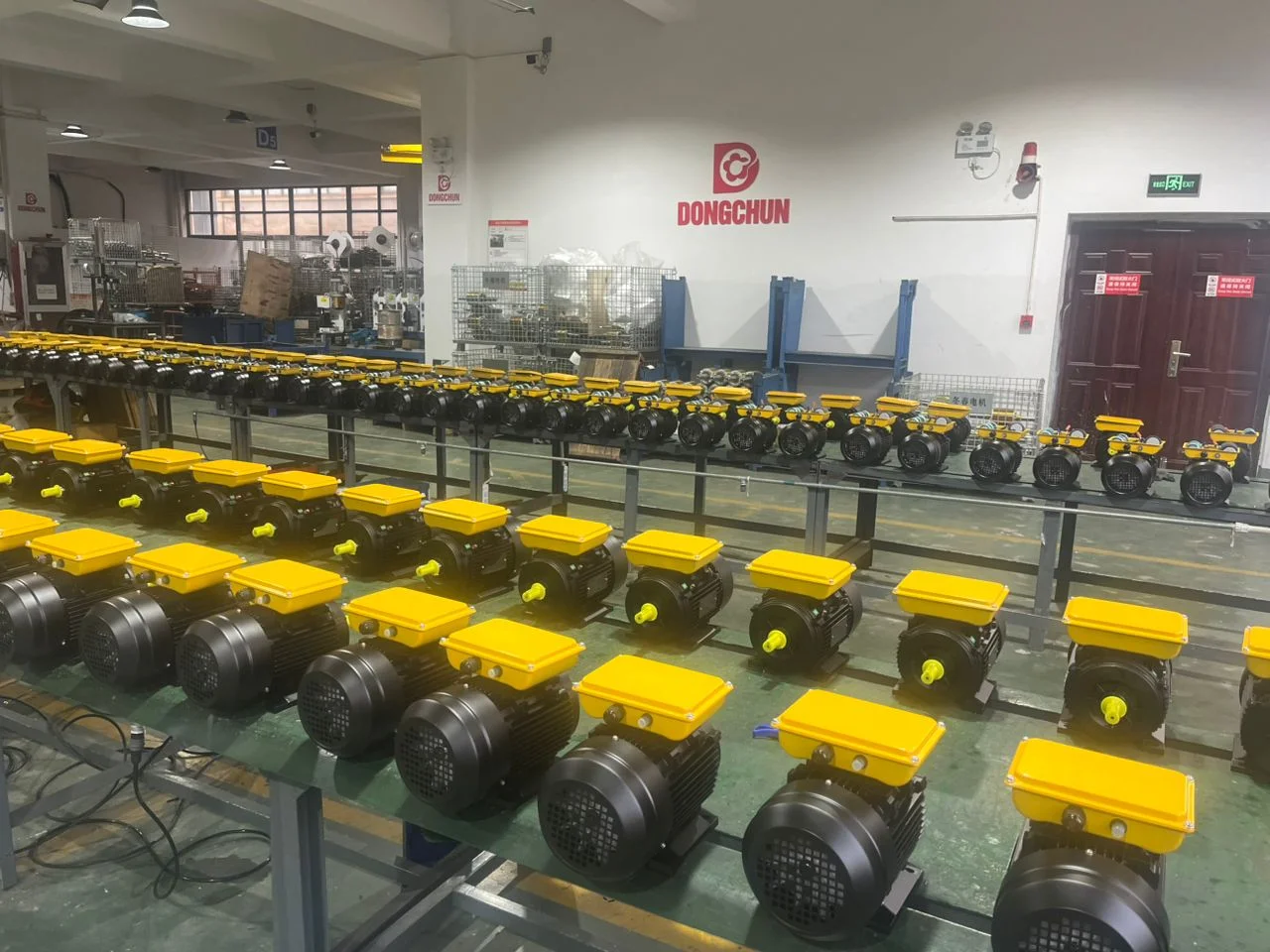
Buying motors from China? Inflated HP ratings are a real risk. Here is how to protect your business from overstated motor power.
Many Chinese motor factories exaggerate horsepower (HP) ratings on nameplates to win price competitions. A motor labeled "5 HP" may only deliver 3.5–4 HP under load. To spot fake ratings, check for missing efficiency class labels (IE2/IE3), request third-party test reports, compare the motor's frame size and weight against IEC standards, and verify certifications like ISO 9001, CE, or TUV. Trustworthy suppliers provide full test data and welcome factory audits.
Below, we answer every question procurement buyers ask about inflated Chinese motor ratings.
How Common Are Inflated HP Ratings on Chinese Motors?
More common than most buyers realize. Understanding the scale of this problem is the first step to protecting your orders.
Inflated HP ratings affect an estimated 15–30% of low-cost Chinese motors sold through trading companies. The problem is concentrated among uncertified factories and middlemen who relabel motors to appear more powerful. Reputable manufacturers with ISO 9001, CE, and IE3 certifications — such as Dongchun Motor — consistently deliver rated power because their production lines undergo regular third-party audits.
Why Do Some Factories Inflate Ratings?
The root cause is price pressure. When international buyers send RFQs (Request for Quotation) to multiple suppliers, the lowest price usually wins. Some factories discovered a shortcut: instead of building a true 5 HP motor with the correct copper windings, lamination stack, and frame size, they build a 3.5 HP motor and simply stamp "5 HP" on the nameplate. The material savings are significant.
Here is a simplified cost comparison to show why this fraud is tempting:
Composant
True 5 HP Motor
Fake "5 HP" (Actually 3.5 HP)
Savings for Factory
Copper wire (kg)
4.8 kg
3.2 kg
~$12 USD
Lamination stack height (mm)
135 mm
100 mm
~$6 USD
Frame size
112M
100L
~$5 USD
Shaft diameter (mm)
28 mm
28 mm (unchanged to look correct)
$0
Total material cost
~$78
~$55
~$23 per unit
Now multiply those savings by 500 or 1,000 motors per container. A dishonest factory pockets $11,500–$23,000 per shipment in material savings alone. The buyer receives motors that overheat, underperform, and fail within months.
Who Are the Worst Offenders?
The problem is not evenly spread across all Chinese motor manufacturers. Based on industry audits and buyer complaints, here is where inflated ratings appear most:
Trading companies without factories— They buy from the cheapest source and have no quality control. They cannot even verify what is inside the motor.
Small workshops (under 20 employees)— These operations lack testing equipment and rely on manual winding. Consistency is impossible.
Factories targeting price-only buyers— If a factory's entire sales pitch is "cheapest price," the savings have to come from somewhere.
Factories refusing third-party inspection— Legitimate manufacturers welcome SGS, Bureau Veritas, or TUV inspections. Factories that resist have something to hide.
In contrast, established manufacturers with export certifications maintain strict quality because their certifications depend on it. Losing an ISO 9001 or CE certificate would cost them far more than the margin gained from cheating on one order.
How Does This Affect Your Business?
When you install an inflated-rating motor in a pump, compressor, or conveyor, the motor runs above its actual capacity. The consequences hit fast:
Surchauffe: The motor draws more current than designed, causing winding insulation to degrade. Failure follows within 3–12 months.
Reduced output: Your machine does not reach its expected throughput. A water pump moves less water. A crusher processes less material.
Higher electricity bills: An overloaded motor operates at poor efficiency, wasting 15–25% more energy.
Warranty disputes: The motor fails, and the supplier blames your "operating conditions." Without independent test data, you have no proof.
Customer complaints: If you resell these motors, your customers come back to you — not the Chinese factory.
Inflated HP ratings only affect single-phase motors, not three-phase industrial motors.FAUX
Inflated ratings affect both single-phase and three-phase motors. Three-phase motors are actually more commonly affected in export markets because they are sold in larger quantities and the per-unit savings from using less copper and steel are more significant at scale. Independent audits have found HP exaggeration in motors from 0.5 HP single-phase all the way up to 30 HP three-phase models.
A motor's frame size and weight are reliable physical indicators of its true power rating — a genuine 5 HP motor should be noticeably heavier than a 3 HP motor of the same type.Vrai
IEC and NEMA standards specify frame sizes for each power rating. A genuine IEC 5 HP (3.7 kW) motor uses a 112M frame and weighs approximately 35–42 kg. If a motor labeled 5 HP uses a 100L frame or weighs only 25 kg, the rating is almost certainly inflated. Comparing weight and frame dimensions against published IEC standards is one of the fastest ways to detect fraud.
What Are the Warning Signs of Fake Motor HP Ratings?
You do not need to be an engineer to spot suspicious motors. A few simple checks can save your company thousands of dollars.
The five clearest warning signs of inflated motor ratings are: (1) motor weight is 20% or more below IEC standard for its rated power, (2) frame size is one or two sizes smaller than expected, (3) no efficiency class marking (IE1/IE2/IE3) on the nameplate, (4) supplier refuses to provide a third-party test report, and (5) price is significantly below market average for the rated power. Any two of these signs together should raise a red flag.
The Weight Test — Your Simplest Tool
Every motor power rating corresponds to a specific range of weight. This is physics, not opinion. More power requires more copper in the windings and more steel in the laminations. You cannot cheat physics.
Here is a reference table for standard IEC three-phase motors (2-pole and 4-pole, aluminum frame, IE2 efficiency):
Puissance nominale
IEC Frame Size (4-pole)
Expected Weight Range
Suspicious If Below
0.75 kW (1 HP)
80M
12–15 kg
10 kg
1.5 kW (2 HP)
90L
18–22 kg
15 kg
2.2 kW (3 HP)
100L
24–29 kg
20 kg
3.7 kW (5 HP)
112M
35–42 kg
28 kg
5.5 kW (7.5 HP)
132S
48–58 kg
40 kg
7.5 kW (10 HP)
132M
58–70 kg
48 kg
11 kW (15 HP)
160M
90–110 kg
75 kg
15 kW (20 HP)
160L
110–135 kg
90 kg
22 kW (30 HP)
180L
155–185 kg
130 kg
When your shipment arrives, weigh random samples on a platform scale. If the average weight falls below the "Suspicious" column, you have strong evidence of inflated ratings.
The Frame Size Check
IEC 60034 assigns standard frame sizes to each power rating. A 5 HP (3.7 kW) 4-pole motor should use a 112M frame. If you receive a motor stamped "5 HP" but the frame measures as a 100L, the motor is almost certainly a 2.2 kW (3 HP) motor with a fake nameplate.
How to measure frame size without special tools:
Shaft center height: Measure from the bottom of the motor feet to the center of the shaft. A 112 frame has a 112 mm center height. A 100 frame has 100 mm.
Foot hole spacing: Measure the distance between mounting bolt holes. Each frame size has a unique pattern defined by IEC standards.
Shaft diameter: While some dishonest factories use the correct shaft diameter for the claimed rating (to avoid obvious detection), many use the smaller shaft that matches the actual motor size.
You can download free IEC frame dimension charts fromIEC motor dimension referenceor request them from your supplier.
The Nameplate Inspection
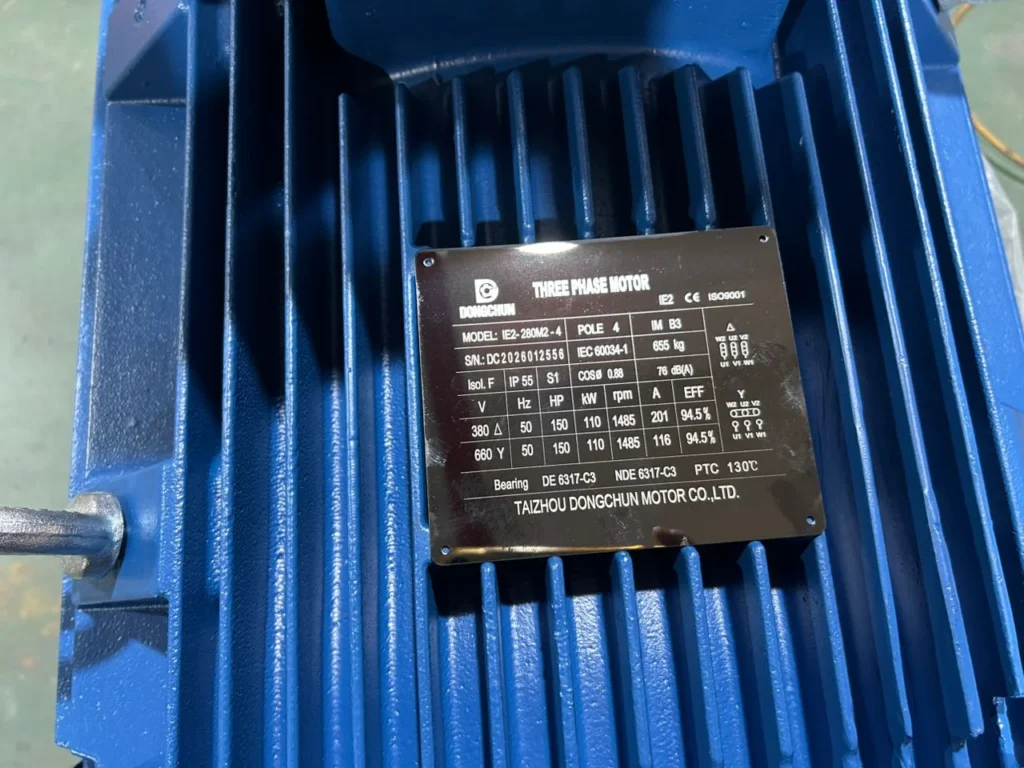
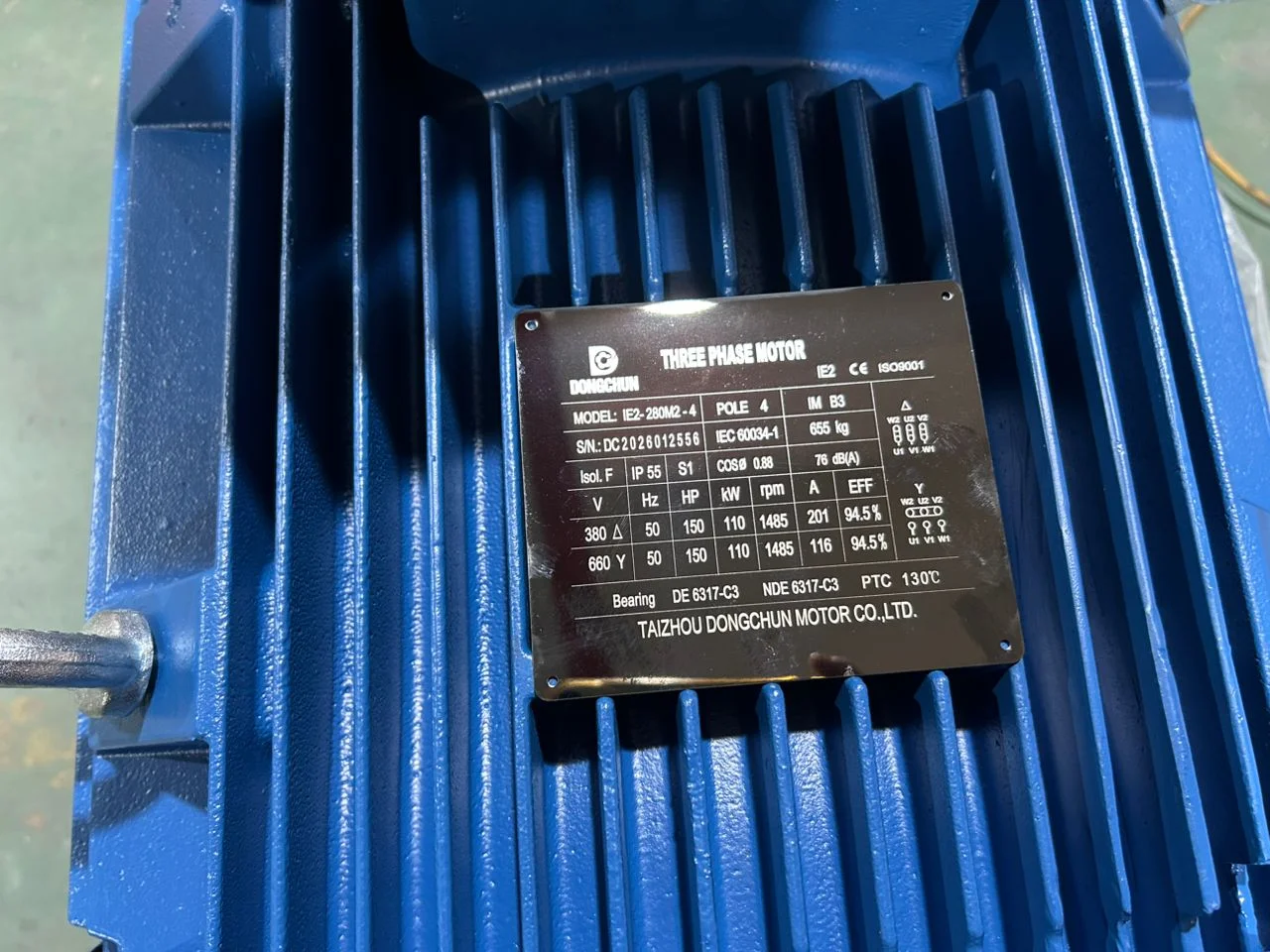
A legitimate motor nameplate includes all of these items:
Manufacturer name and logo
Motor model number
Rated power (kW and/or HP)
Rated voltage and frequency
Rated current (Amps)
Rated speed (RPM)
Efficiency class (IE1, IE2, IE3, or IE4)
Power factor (cos φ)
Insulation class (B, F, or H)
Protection rating (IP55, IP54, etc.)
Duty cycle (S1 continuous, S2 short-time, etc.)
Manufacturing date or serial number
Certification marks (CE, ISO, TUV, etc.)
Red flags on the nameplate:
Missing efficiency class — a factory that does not test efficiency will not print it
Rated current that seems too low for the stated HP — this means the motor cannot actually draw enough power to produce the claimed output
No certification marks at all
Generic "Made in China" with no factory name or address
Sticker nameplate instead of riveted aluminum plate (stickers can be easily replaced)
The Price Reality Check
Motor prices follow a predictable pattern based on materials cost. When a quote breaks significantly below this pattern, something is wrong.
Motor Rating
Normal FOB Price Range (IE2, 4-pole)
Suspiciously Low Price
1.5 kW (2 HP)
$38–55
Below $28
3.7 kW (5 HP)
$68–95
Below $50
7.5 kW (10 HP)
$115–160
Below $85
15 kW (20 HP)
$210–290
Below $155
30 kW (40 HP)
$380–520
Below $280
Prices are approximate FOB China, 2024–2025, for standard aluminum-frame motors. Cast iron frames cost 15–30% more.
If a supplier quotes a 5 HP motor at $42 FOB when the market range is $68–95, they cannot be using enough copper and steel to build a true 5 HP motor. The math simply does not work.
You can detect inflated motor ratings just by looking at the nameplate — if the nameplate has a CE mark, the motor is guaranteed to meet its rated specifications.FAUX
While CE marking indicates compliance with European directives, counterfeit CE marks are widespread on low-cost exports. A printed CE symbol alone does not guarantee anything. You need to verify the CE certificate number with the issuing body, request the Declaration of Conformity, and ideally confirm through a third-party testing agency. Some factories print fake CE marks alongside inflated ratings.
Comparing a motor's actual weight against IEC standard weight ranges is a practical, low-cost method for procurement officers to detect potentially inflated power ratings.Vrai
IEC standards define frame sizes for each power rating, and frame size directly determines the amount of steel and copper in the motor — which determines weight. A motor that is significantly lighter than the IEC standard for its claimed rating almost certainly contains less active material and cannot produce the rated output. This method requires only a scale, making it accessible to any buyer at any warehouse or port.
How Can You Verify a Motor's True HP Before Buying?
Prevention is cheaper than returns. A few steps during the sourcing process will eliminate most risk.
To verify motor HP before purchase, request these five documents: (1) a third-party test report from an accredited lab (SGS, TUV, Bureau Veritas, or Intertek), (2) the motor's type test certificate showing efficiency and power measurements, (3) photos of the motor being tested on a dynamometer, (4) a Declaration of Conformity for CE or other certifications, and (5) reference customer contacts who can confirm quality. Any manufacturer that delivers all five without hesitation is worth your business.
Step 1: Request Third-Party Test Reports
A third-party test report is your strongest protection. Accredited laboratories test the motor's actual output power, efficiency, current draw, temperature rise, and vibration levels under controlled conditions.
Laboratories with strong reputations for motor testing include:
Tuv Rheinland(Germany, with labs in China)
GV(Switzerland, with labs in China)
Bureau Véritas(France, with labs in China)
Intertek(UK, with labs in China)
CQC(China Quality Certification Center)
CSA Group(Canada)
When you receive a test report, check these items:
Report date: Should be recent (within 2 years) and match the motor model you are buying
Lab accreditation number: Should be verifiable on the lab's website
Tested power output: Should match or exceed the nameplate rating
Efficiency at 75% and 100% load: Should match the claimed IE class
Motor serial number on report: Should match a production sample, not a specially prepared test unit
Step 2: Compare Against IEC Standards
IEC 60034-1 and IEC 60034-30-1 define performance standards for electric motors worldwide. These are not suggestions — they are internationally recognized specifications.
Key IEC checks for procurement buyers:
What to Check
IEC Standard
What It Tells You
Frame size vs. power
IEC 60034-1
Whether the physical size matches the claimed power
Efficiency class
IEC 60034-30-1
Whether the motor meets IE1, IE2, IE3, or IE4
Temperature rise
IEC 60034-1
Whether the motor can run continuously without overheating
Noise levels
IEC 60034-9
Indirectly reveals build quality
Vibration levels
IEC 60034-14
Reveals balance quality and bearing condition
You do not need to read these standards yourself. Simply ask your supplier: "Does this motor comply with IEC 60034-1 and IEC 60034-30-1? Please provide the compliance documentation." A legitimate manufacturer answers immediately. A dishonest one stalls.
Step 3: Order Samples and Test Them
Before placing a container order, buy 2–3 sample motors. Then:
Weigh themand compare against the IEC frame size table above
Measure the frame dimensions(shaft center height, foot hole spacing)
Run them under loadif you have access to a dynamometer or even a simple brake test
Check the winding resistancewith a multimeter — lower resistance than expected means less copper
Monitor temperatureduring a 2-hour full-load run — excessive heat indicates the motor is undersized for its rating
If you do not have testing equipment, hire a local motor repair shop or engineering lab to run these checks. The cost is typically $50–200 per motor — far less than the cost of a container of defective motors.
Step 4: Factory Audit
For large orders (10,000 USD and above), a factory audit is worth the investment. You can hire SGS, Bureau Veritas, or a specialized motor industry auditor to visit the factory and verify:
Production equipment and testing facilities
Raw material quality (copper wire grade, lamination steel grade)
Quality control processes and inspection records
Nameplate accuracy versus actual production
Worker training and safety practices
Dongchun Motor, for example, maintains an open-door policy for buyer audits and provides full dynamometer test data for every motor series. Their IE3 certified production line is regularly audited by TUV, which means the ratings you see on the nameplate are the ratings you get in the field. You can learn more athttps://iecmotores.com.
Step 5: Use Payment Terms That Protect You
Structure your payment to maintain leverage:
30% deposit, 70% after inspection— The most common arrangement for verified suppliers
Letter of Credit (L/C)— Your bank only releases payment when shipping documents meet agreed specifications
Include quality clauses in your purchase contract— Specify that motors must meet IEC 60034-1 rated output, and define the penalty for non-compliance (replacement, refund, or discount)
Third-party test reports from accredited laboratories like TUV or SGS can be easily faked, so they offer no real protection against inflated motor ratings.FAUX
While document fraud exists, accredited lab reports include verifiable details: lab accreditation numbers, unique report IDs, testing engineer signatures, and QR codes or online verification portals. Buyers can contact the laboratory directly to verify any report's authenticity. A factory that provides a genuinely accredited test report has invested significant money and effort into compliance, making it highly unlikely they would undermine that investment with inflated ratings.
Ordering 2–3 sample motors and testing them before placing a full container order is an effective strategy to detect inflated HP ratings before committing to a large purchase.Vrai
Sample testing allows buyers to weigh motors, measure frame dimensions, check nameplate accuracy, and even perform load tests — all before spending tens of thousands of dollars. While a dishonest factory could theoretically send better samples than bulk production, combining sample testing with a pre-shipment inspection of the actual container goods covers both risks. This two-step approach is recommended by trade compliance experts worldwide.
What Should You Do If You Already Received Inflated-Rating Motors?
It happens. You opened the container and suspect the motors are weaker than promised. Here is your action plan.
If you suspect inflated ratings on delivered motors, act immediately: (1) document everything with photos, weight measurements, and nameplate close-ups, (2) hire an independent lab to test actual power output, (3) file a formal complaint with the supplier including test evidence, (4) escalate through your trade assurance platform (Alibaba, Global Sources, etc.) or payment provider, and (5) report the fraud to the relevant Chinese industry authority (AQSIQ) if the supplier refuses to resolve it.
Immediate Documentation
Within the first 48 hours of receiving your shipment:
Photograph every motor— nameplate close-ups, overall motor from multiple angles, packaging labels, shipping marks
Weigh at least 10% of the shipmenton a calibrated scale — record the weight of each motor alongside its nameplate rating
Save all purchase documents— purchase order, proforma invoice, commercial invoice, packing list, bill of lading, and all email/chat communications with the supplier
Do not install the motors— using them weakens your claim for a full refund or replacement
Getting an Independent Test
Contact a local motor testing laboratory or university engineering department. Most countries have at least one facility capable of dynamometer testing. Provide them with:
2–3 motors from the shipment (selected randomly)
The nameplate specifications (claimed power, voltage, frequency, efficiency class)
A request to test actual shaft power output at 75%, 100%, and 110% of rated load
The test report becomes your primary evidence. It will show the actual power output versus the claimed rating in clear, measurable terms.
Approximate cost for independent motor testing by region:
Région
Typical Cost Per Motor
Common Labs
l'Amérique latine
$80–200 USD
University labs, national standards bodies
Africa
$100–300 USD
Bureau of Standards, university labs
Southeast Asia
$60–150 USD
SIRIM (Malaysia), TISI (Thailand)
Middle East
$100–250 USD
ESMA (UAE), SASO-affiliated labs
Europe
$150–400 USD
TUV, SGS, national metrology institutes
Filing Your Complaint
When contacting the supplier, include:
Your purchase order number and invoice
Photos and weight measurements
Independent test report showing actual vs. claimed power
A clear statement of what you want: full replacement, partial refund, or full refund
Keep your tone professional but firm. State facts, not emotions. Give a reasonable deadline (14–21 days) for a response.
If the supplier does not respond or refuses to compensate:
Alibaba Trade Assurance— If you purchased through Alibaba, open a dispute through the Trade Assurance system. Alibaba can force a refund from the supplier's deposit.
PayPal/credit card chargeback— If you paid through PayPal or credit card, file a dispute with your payment provider.
Letter of Credit— If you used an L/C, contact your bank about discrepancies between the L/C terms and the delivered goods.
Legal action— For large orders, consult a lawyer specializing in China trade law. Organizations like the China-Britain Business Council or your country's trade office in China can provide referrals.
Preventing It Next Time
Every bad experience is a lesson. For your next order:
Switch to a certified manufacturer with verifiable credentials. Dongchun Motor's full product range carries ISO 9001, CE, and TUV certifications, with a 2-year warranty that covers rated performance. Transparent testing and open factory audits mean you verify before you buy, not after. See the full catalog athttps://iecmotores.com.
Always test samples before placing bulk orders
Include quality penalty clauses in your contract
Arrange pre-shipment inspection by a third party
Build long-term relationships with one or two trusted suppliers instead of constantly chasing the lowest price
If you received inflated-rating motors, you should install and use them at reduced load rather than pursuing a complaint — the motors will work fine at lower capacity.FAUX
Running motors that were fraudulently labeled is risky even at reduced load, because the actual specifications (insulation class, bearing ratings, thermal design) may also be substandard — not just the power rating. Additionally, installing the motors eliminates your ability to claim a full refund, as the supplier will argue the goods were accepted and used. The correct approach is to document, test, and file a complaint before installation.
Buyers who document weight discrepancies, nameplate photos, and independent test results have significantly stronger positions in trade disputes and payment chargebacks than those who only report subjective performance complaints.Vrai
Trade assurance platforms, banks processing L/C disputes, and credit card chargeback departments all require objective evidence. A test report from an accredited lab showing that a motor labeled 5 HP only produces 3.2 HP is undeniable proof. Weight measurements that fall 25% below IEC standards are objective data points. In contrast, complaints like 'the motor seems weak' or 'it runs hot' are subjective and easily disputed by the supplier. Documentation is the foundation of every successful quality complaint.
Conclusion
Inflated Chinese motor ratings are a real problem, but a solvable one. Weigh your motors, check frame sizes, demand third-party test reports, and buy from certified manufacturers. A few hours of due diligence saves thousands of dollars and years of headaches. Choose suppliers who welcome transparency — your business depends on it.
References
IEC 60034-1:2022 — Rotating electrical machines, Part 1: Rating and performance. International Electrotechnical Commission.https://www.iec.ch/homepage
IEC 60034-30-1:2014 — Efficiency classes of line operated AC motors. International Electrotechnical Commission.https://www.iec.ch/homepage
 Aller au contenu